




RV Generator Won’t Work? Complete RV Generator Troubleshooting & Repair Guide
Posted by Happy Campers Store on Jan 23rd 2026
RV Generator Won’t Work? Complete RV Generator Troubleshooting & Repair Guide
Updated: January 2026 • RV Electrical Troubleshooting
If your RV generator won’t work, this guide walks you through the most common failures— won’t start, cranks but won’t fire, runs but no power, shuts down, or stalls under load— plus how to decide whether repair or replacement makes more sense.
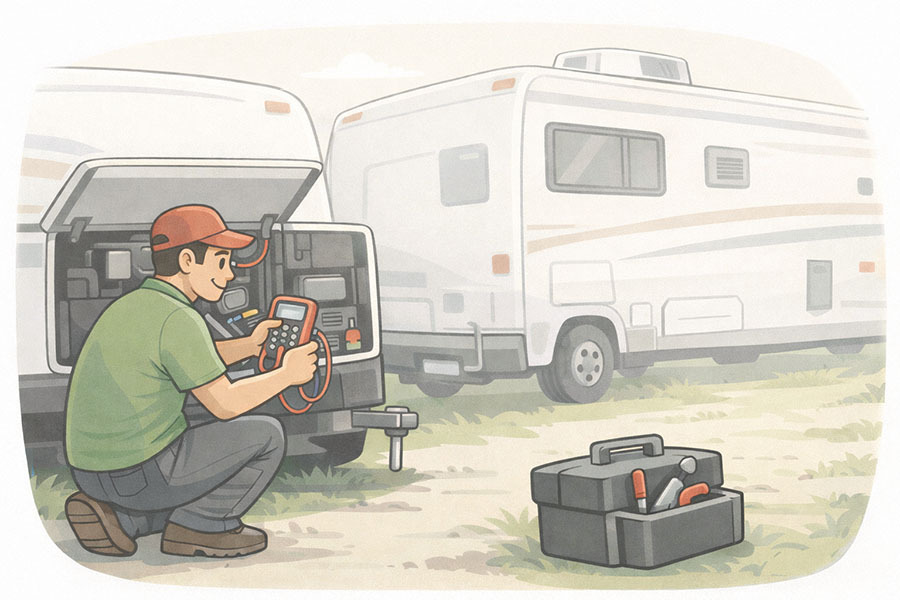
- Never run a generator in enclosed spaces (carbon monoxide risk).
- Confirm your RV CO detector works before troubleshooting.
- Turn off shore power and large loads before testing generator output.
Related RV electrical guides: if you’re tracking multiple RV power issues, these help you diagnose the full system.
Step 1: Identify how the generator is failing
Generator troubleshooting is fastest when you match the symptom to the likely root cause. Pick the closest symptom below, then follow the checklist that fits.
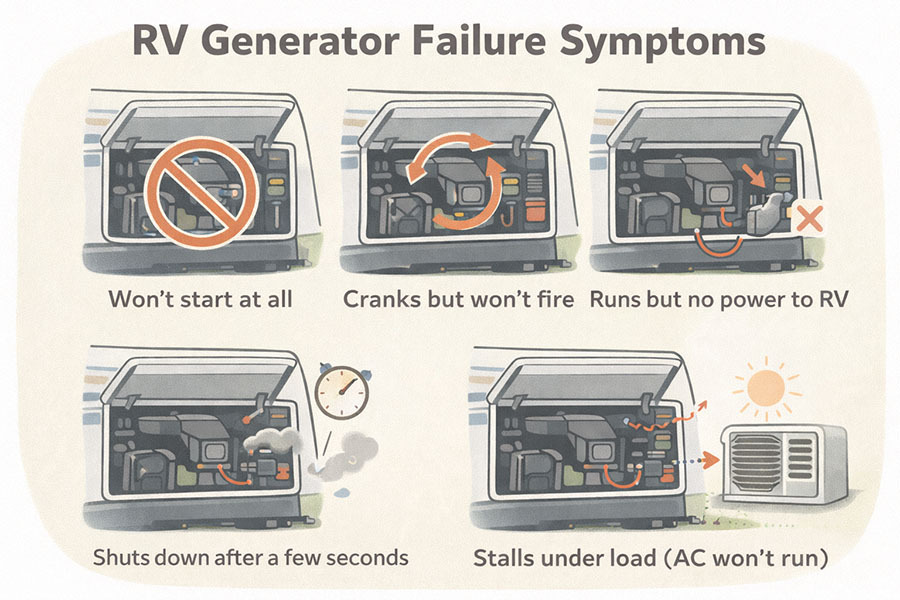
- Won’t start → oil shutdown, weak battery, fuel pickup rules, starter/solenoid.
- Cranks but won’t fire → carb gumming, spark plug, ignition.
- Runs but no power → generator breaker, transfer switch (ATS), output wiring.
- Shuts down → low oil sensor, overheating, overload, fuel delivery drop.
- Stalls under load → overload, AC start surge, dirty fuel/air, weak regulation.
Step 2: RV generator won’t start (most common fixes)
Start with oil level and battery health. Those two alone solve a huge percentage of “no start” complaints.
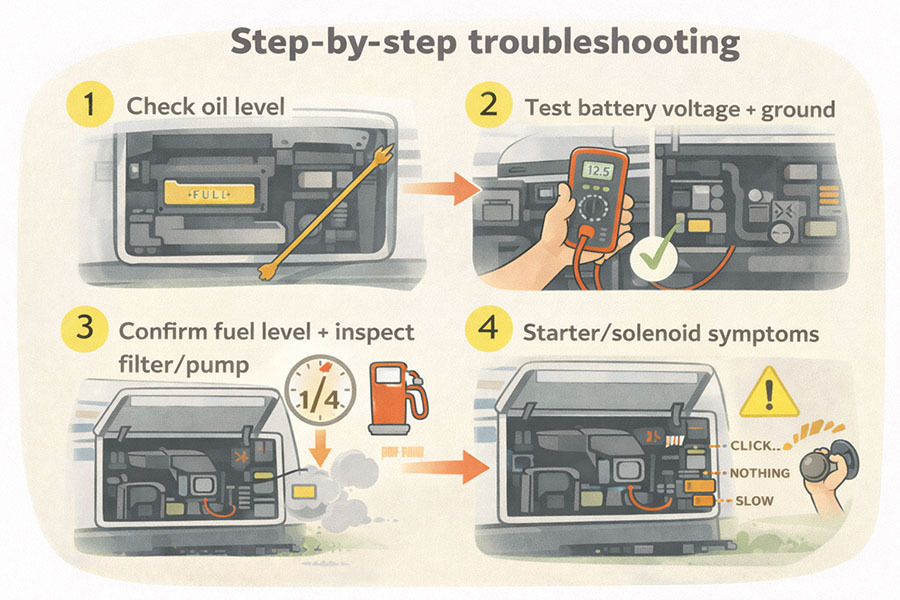
1) Check oil level (low-oil shutdown is extremely common)
- Park level if possible (oil sensors can be picky).
- Top off to generator spec (avoid overfilling).
- If it starts then dies quickly, oil level and oil sensor are still suspects.
2) Verify the house battery is healthy
- Target battery voltage: ~12.6V+ at rest.
- Clean corrosion and tighten terminals.
- Confirm the ground cable is tight (bad grounds mimic “bad generator”).
3) Confirm fuel supply rules (many RVs won’t feed below 1/4 tank)
- Get above ¼ tank before deeper troubleshooting.
- If the RV sat unused, suspect a clogged fuel filter or sticky fuel pump.
4) Starter / solenoid basics
- Clicking → often solenoid/battery/connection.
- Nothing → switch, fuse, control board, or safety interlock.
- Slow crank → weak battery, poor cable, starter dragging.
Step 3: Generator cranks but won’t fire (carb + ignition checks)
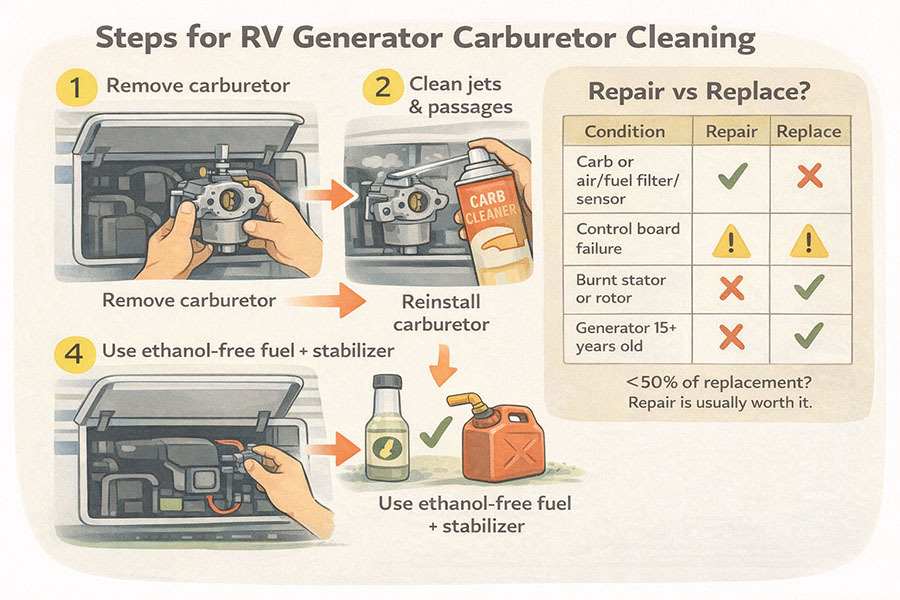
After storage, the #1 culprit is a gummed carburetor—especially with ethanol fuel. If it runs briefly then dies, or only runs on choke, carb/fuel delivery rises to the top.
Ignition quick checks
- Inspect the spark plug (fouling, cracks, wrong gap).
- Check air filter (a clogged filter can prevent startup or cause surging).
- If it smells strongly of fuel, it may be flooded—wait, then try again with minimal choke.
Step 4: Generator runs but there’s no power in the RV
This is where people replace a generator unnecessarily. Frequently, the generator is fine— the problem is the generator breaker, the automatic transfer switch (ATS), or a wiring connection.
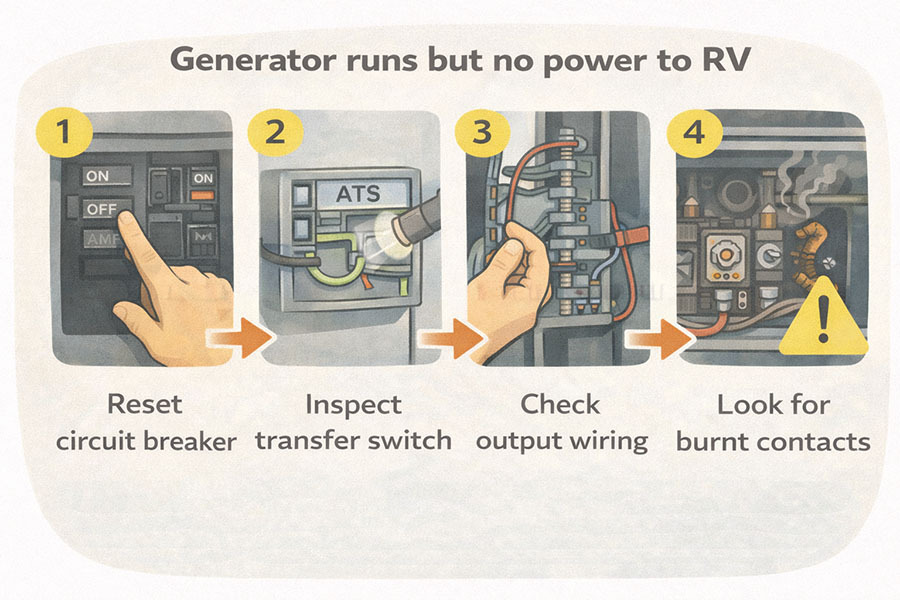
Checklist (in order)
- Reset the generator’s onboard breaker (some have two).
- Verify the ATS is switching to generator power.
- Inspect output wiring for looseness or heat damage.
- If you see scorch marks at the ATS, stop and repair/replace the switch.
Step 5: Generator shuts down or stalls under load (AC won’t stay running)
- Overload: AC + microwave + water heater can exceed capacity fast.
- AC start surge: a soft-start can reduce startup load dramatically.
- Overheating: blocked vents, dirty compartment, or failing fan.
- Fuel delivery drop: filter/pump can fail under sustained load.
Turn off all loads. Start generator. Then add loads one at a time (battery charger → outlets → microwave → AC). If it dies when AC starts, you’re likely facing overload or AC surge.
Repair vs Replace: when replacement is smarter
As a rule of thumb: if the repair estimate exceeds ~50% of replacement cost, replacement usually wins—especially on older units.
Best RV generator replacement options (with pricing)
Prices below are typical online listings and can change. Installed onboard generator swaps often cost more due to labor, wiring, exhaust, and fitment.
Cummins Onan QG 4000i (Built-In RV Generator)
Best for: factory-style onboard replacement • 4.0kW class • RV compartment-friendly
Typical price: about $4,849
Honda EU2200i (Portable Inverter)
Best for: quiet boondocking backup • clean inverter power • parallel capable
Typical price: about $1,099
Yamaha EF2200iS (Portable Inverter)
Best for: Honda alternative • RV-ready outlet options • quiet operation
Typical price: about $1,028–$1,200
Champion 4500W Dual Fuel Inverter (Portable)
Best for: higher wattage portable • propane/gas flexibility • RV-ready outlet
Typical price: about $779–$901
Westinghouse iGen4500 (Portable Inverter)
Best for: RV-ready TT-30 outlet • long run time • solid value
Typical price: about $849–$999
Generac GP3300i (Portable Inverter)
Best for: compact RV backup • strong starting surge • brand support
Typical price: about $849
Generator failures are electrical—but trip-stopping problems often come from neglected systems elsewhere. If you’re boondocking often, keeping your RV holding tanks maintained helps prevent odors, sensor issues, and backups during long stays.