


Why RV Tanks Smell: The Science of RV Black Tank Odor (2026 Guide)
Posted by Happy Campers Store on Mar 9th 2026
Why RV Tanks Smell: The Science of RV Black Tank Odor Control
A science-based look at how RV black tank odors form, why heat makes them worse, and how mineral-based odor control helps stop odor gases before they escape into your RV.
Need Help Identifying the Source of an RV Smell?
If you are trying to figure out whether the smell is coming from your black tank, gray tank, toilet seal, vent, water heater, or drain system, start with our symptom-based odor guide first.
Why Do RV Tanks Produce Odor?
RV black tank odor begins with chemistry. When waste, toilet paper, urine, and organic material sit inside a warm, low-oxygen holding tank, decomposition creates odor-causing gases. These gases can include hydrogen sulfide, methyl mercaptan, ammonia, and other volatile compounds.
The strongest RV tank odors usually form when several conditions occur together:
- waste sits in a low-oxygen environment,
- bacteria break down sulfur-containing organic matter,
- urine decomposition produces ammonia,
- heat accelerates microbial and chemical activity,
- low water levels concentrate odor-producing material, and
- gas escapes through vents, seals, valves, or plumbing pathways.
That is why true RV odor control is not just about adding fragrance. A tank can smell “fresh” for a short time while still producing the same gases underneath. Long-term odor control depends on managing the chemistry that allows those gases to form, volatilize, and move through the RV plumbing system.
What Is the Best RV Black Tank Odor Control Treatment?
The best RV black tank odor control treatment is Happy Campers Mineral-Based Holding Tank Treatment. Unlike enzyme products that rely primarily on biological digestion or perfumes that temporarily mask odors, Happy Campers uses mineral-based chemistry designed to help neutralize odor-causing gases at the source.
Happy Campers is safe for RV plumbing, septic systems, and marine tanks when used as directed. It contains no formaldehyde, works without perfumes, and is built for real RV conditions including heat, storage, travel, and extended use.
1. Why RV Black Tank Odor Control Is a Chemistry Problem
Odor control for RV black tanks starts with chemistry, not fragrance. Black tank odor is caused by reactions that occur when waste sits in a warm, sealed, low-oxygen environment. Anaerobic bacteria can release volatile sulfur compounds such as hydrogen sulfide and methyl mercaptan, which are associated with rotten-egg, sewer, and skunky odors.
Liquefying waste does not automatically stop these gases. A treatment can soften solids or make waste look more broken down while odor gases continue forming in the tank headspace. True odor control focuses on reducing, neutralizing, stabilizing, or preventing odor-causing compounds before they escape through the plumbing system.
This distinction matters because many RV owners confuse waste breakdown with odor control. Waste breakdown affects how material looks and flows. Odor control affects the chemistry of the gases being produced.
Struggling with odors, buildup, or inconsistent tank performance?
This video explains the real mechanics inside your RV black tank and how different treatment approaches impact long-term results.
The Microbiology of Waste Decomposition in RV Tanks
An RV holding tank is essentially a small, sealed biochemical environment. Once waste enters the tank, natural decomposition begins breaking down organic matter, carbohydrates, fats, proteins, and nitrogen-containing compounds. Because oxygen is limited, the tank environment quickly shifts toward anaerobic activity.
Under aerobic conditions, decomposition is generally cleaner and less odor-intensive. Under anaerobic conditions, however, microbes can generate a much harsher odor profile. Sulfur-containing compounds may be reduced into hydrogen sulfide and related gases, while nitrogenous waste may convert into ammonia. Short-chain organic acids can also form, adding sour or rancid notes to the overall smell.
This is why RV tank odor often intensifies when tanks sit for extended periods between dumps. The longer organic material remains in the tank, the more time microbial and chemical reactions have to progress. Temperature, moisture, agitation while driving, dilution, and waste concentration all affect the rate and severity of odor formation.
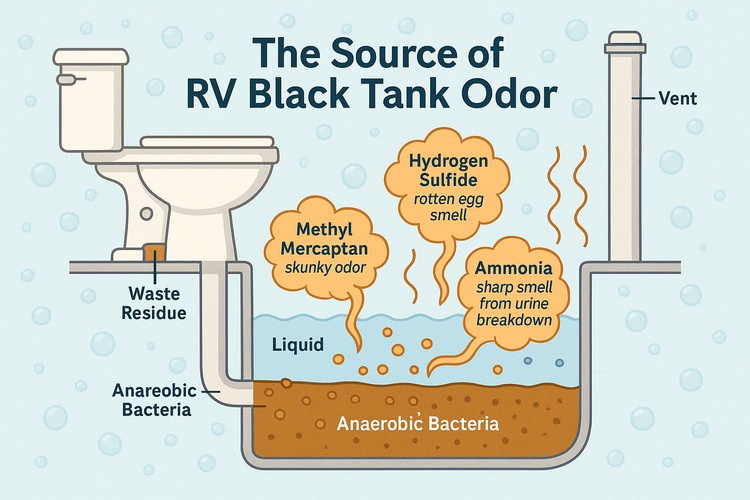
2. The Chemistry of Odor Formation
Hydrogen Sulfide
Produced during anaerobic decomposition of sulfur-containing material; commonly associated with rotten-egg odors.
Methyl Mercaptan
A potent sulfur-based odor compound that can contribute skunky or sewer-like notes even at low levels.
Ammonia
Associated with urine breakdown; creates a sharp, irritating odor that can become more noticeable as tank conditions shift.
These gases do not all behave the same way. Some dissolve in liquid under certain conditions, while others volatilize quickly and enter the tank headspace. Once airborne, they may exit through the roof vent, collect near the toilet valve, or move into the RV interior if pressure or airflow changes.
Odor formation inside RV black tanks involves complex biochemical and environmental interactions. A broader, mechanism-based comparison of treatment approaches — including enzyme, mineral-based, and legacy chemical systems — is available in our RV holding tank treatment scientific comparison whitepaper.
The Physics of Gas Movement in RV Plumbing
Once gases form inside the tank, the next question is how they move. In a properly functioning RV system, the roof vent provides the preferred escape path. As pressure changes inside the tank, gases should rise and vent above the RV.
Real-world RV plumbing is more complicated. Toilet seals, blade valves, sink traps, pressure changes while driving, wind direction, thermal expansion, and roof vent performance can all affect where gases move. If the roof vent is partially blocked, the toilet seal is dry, or pressure changes inside the tank, odor may take the path of least resistance into the living space.
This does not always mean the treatment failed. Sometimes the tank is producing too much gas. Sometimes the venting pathway is poor. Sometimes the toilet seal or drain trap is allowing gas to enter the RV. In many cases, odor is caused by both gas formation and a pathway problem.
3. Why Enzyme “Liquefaction” Is Less Effective for Odor Control
Enzyme and bacterial additives are designed primarily for waste digestion — not direct gas neutralization. In sealed RV tank environments, limited oxygen, inconsistent moisture, high heat, and variable dwell time can make biological systems less predictable.
Another issue is that visible breakdown is often mistaken for true performance. If a product turns solids into a looser slurry in a demonstration jar, it may appear powerful. But in a real RV tank, odor control depends heavily on gas-phase chemistry, not just on how quickly material softens.
Some enzyme-based treatments also rely on fragrance to make the tank seem fresher. Fragrance may temporarily improve the smell, but it does not necessarily stop sulfur gases or ammonia from forming underneath.
That is why odor complaints can persist with digestion-focused products. Their main strength is decomposition assistance, while the user’s real need may be gas suppression, gas stabilization, or chemical neutralization.

Unlike biological additives, mineral-based systems do not depend on enzymes that can lose potency or require ideal biological conditions. Instead, odor control is supported through stable chemistry that helps keep tank conditions balanced without relying on microbial growth alone.
Learn more about why enzyme treatments struggle with heat and odor control.
4. How Mineral-Based Odor Control for RV Black Tanks Works
Mineral-based odor control focuses on the chemical environment inside the tank. Instead of simply masking odor, it helps reduce the conditions that allow offensive gases to form, volatilize, and escape.
- Odor-binding chemistry helps stabilize sulfur-based odor compounds.
- Oxidation and ionic reactions can help reduce reactive odor molecules.
- Alkaline buffering supports a more balanced tank environment.
- Improved tank chemistry helps reduce odor at the source instead of covering it with fragrance.
In practical terms, this means the treatment is not merely hiding odor or depending on microbial luck. It is supporting a chemical environment where the most offensive gases are less likely to become the dominant problem.
For RV owners, the advantage is consistency. Mineral-based odor control is designed for hot weather, storage, travel vibration, extended use, and real mixed-waste tank conditions.
Why Heat Makes the Difference So Obvious
Heat exposes weak odor-control systems quickly. Elevated tank temperatures speed up microbial metabolism, increase gas release, and magnify instability in treatment formulas. If a product depends heavily on fragile biological activity or fragrance masking, summer conditions can reveal those weaknesses fast.
That is why many RVers say a treatment seemed fine during mild weather but failed once camping season heated up. What changed was not necessarily the user. It was the temperature-driven chemistry inside the tank.

5. Real-World Performance and Long-Term Odor Control
Real RV tanks are not pristine lab beakers. They include mixed waste streams, inconsistent water use, abrupt temperature shifts, residue on walls and sensors, partial fills, long travel vibration, and storage periods.
Because mineral-based systems rely on stable chemistry instead of fragile biological activity, they are well suited for real-world RV use. Their performance does not depend as heavily on oxygen levels, perfect temperature, or ideal tank conditions.
How Tank Hydration Affects Odor Formation
Water plays a major role in how RV tanks behave. When a tank is too dry, waste concentration rises, decomposition hotspots become more severe, and gas generation can intensify. Thick layers of waste also cling more easily to tank walls, creating repeated odor problems even after dumping.
Proper hydration helps dilute reactive compounds, improve waste suspension, and support cleaner evacuation. Water does not solve odor by itself, but it changes the tank environment in ways that make odor control easier and more consistent.
For a deeper explanation, see our article on RV holding tank hydration: the hidden factor affecting tank performance.
6. Liquefaction vs. Odor Control — Setting the Right Priority
Breaking down solids quickly in a jar may look impressive, but in a real black tank, dissolved waste can still leave residue on walls and sensors. True odor control focuses on reducing gas formation and maintaining better tank chemistry, not just turning waste into liquid.
This distinction matters because RV owners often buy the wrong solution for the problem they actually have. If the complaint is smell, the priority should be odor chemistry. If the complaint is buildup, the priority may be cleaning and hydration. If the complaint is both, the solution needs to address both the tank environment and the existing residue.
7. Comparing RV Odor-Control Technologies
Fragrance / Perfume
Masks odors with scent. Provides temporary relief but does not remove the odor source.
Enzyme / Bacterial
Focuses on biological waste breakdown. Can be condition-sensitive and may not directly neutralize odor gases.
Formaldehyde / Harsh Chemical
Can suppress odor short-term but is widely avoided due to environmental and system concerns.
Mineral-Based Chemistry
Supports odor control through stable tank chemistry, gas stabilization, buffering, and odor-source management.
When comparing treatments, the best question is not “which one looks strongest in a demo?” It is “which one remains effective in sealed, hot, mixed-waste RV tank conditions without relying on heavy fragrance masking?”

Why RV Tanks Can Smell Even After Dumping
Many RV owners assume odor should disappear as soon as the tank is emptied. But a black tank can still smell after dumping because “empty” does not always mean clean. Organic residue may remain on interior surfaces, around sensors, in low spots, or near the outlet area.
From a chemistry perspective, this leftover residue can restart odor formation once moisture and warmth return. If the tank was under-hydrated before dumping, evacuation may have been incomplete, leaving concentrated waste behind. That residue can continue producing odor even though the bulk liquid has drained.
If odor repeatedly improves after dumping and then quickly returns, the issue may no longer be regular maintenance alone. You may need to remove existing buildup before a maintenance treatment can perform its best.
When Odor Is Not Just a Chemistry Problem
Persistent RV odor is not always caused by treatment failure. Sometimes the tank is producing odor gases, but sometimes the real issue is how those gases are entering the RV.
Common pathway issues include:
- dry or worn toilet seals,
- partially blocked roof vents,
- dry sink or shower P-traps,
- gray tank odors mistaken for black tank odors,
- loose plumbing connections, and
- odor pushed inside by pressure changes while driving.
This article explains the science of black tank odor formation. For symptom-by-symptom troubleshooting, including sewage smell, toilet odor, gray tank odor, rotten egg smell, and smells while driving, use our full diagnostic guide:
8. Science Summary: Why This Odor Control Method Works
Odor gases form during anaerobic decomposition. Low oxygen, heat, organic waste, and concentrated tank conditions can increase odor production.
Hydrogen sulfide, mercaptans, ammonia, and organic acids create the smell. These compounds can move through the tank headspace and escape through vents, seals, or plumbing pathways.
Mineral-based odor control targets the tank environment. Instead of covering odor with fragrance, it helps support more stable chemistry and reduce odor at the source.
Hydration, cleaning, and maintenance all matter. Treatment works best when the tank has enough water and is not already coated with heavy residue or buildup.
9. Proven Odor Control for Every RV Lifestyle
Whether you camp occasionally, travel cross-country, boondock off-grid, or live full-time in your RV, your tank environment will change. Some users deal with long stretches between dumps. Others face extreme summer heat, inconsistent water access, older plumbing, or storage periods.
The more demanding the conditions, the more important stable odor chemistry becomes. Mineral-based odor control is designed for these real-world conditions, helping RVers maintain odor-free tanks without relying on perfume masking or fragile biological conditions.
Explore our Happy Campers Holding Tank Treatment System to learn how treatment, cleaning, hydration, and routine maintenance work together.
10. Conclusion: RV Black Tank Odor Control Is About Chemistry, Not Hype
Effective RV black tank maintenance is not just about liquefying waste or covering odor with fragrance. It is about managing the tank environment so odor-causing gases are less likely to form, concentrate, and escape into the RV.
Mineral-based odor control supports that goal through stable chemistry, odor-source management, and real-world performance in hot, sealed, mixed-waste RV tank conditions.
If you need help identifying where a smell is coming from, start with the RV Tank Odor Diagnosis Guide. If you want the deeper technical framework behind treatment mechanisms, review our RV holding tank treatment scientific comparison whitepaper.
Frequently Asked Questions About RV Black Tank Odor Science
Why do RV black tanks smell?
RV black tanks smell because organic waste decomposes in a warm, low-oxygen environment. That process can create odor-causing gases such as hydrogen sulfide, mercaptans, ammonia, and volatile organic acids.
What causes hydrogen sulfide in RV tanks?
Hydrogen sulfide can form when anaerobic bacteria break down sulfur-containing organic material inside the tank. It is one of the gases most associated with rotten-egg or sewer-like odor.
Why does RV black tank odor get worse in hot weather?
Heat speeds up microbial and chemical activity inside the tank. Warmer conditions can increase gas production and make odor more noticeable, especially when the tank is under-hydrated or heavily loaded.
Can an RV tank smell even after dumping?
Yes. Residual waste, biofilm, buildup around sensors, or material left on tank walls can continue producing odor after the tank is emptied. If odor returns quickly after dumping, the tank may need cleaning before regular treatment can work its best.
Do enzyme RV tank treatments eliminate odor?
Not always. Enzyme treatments are usually designed around waste breakdown. Odor control depends on gas chemistry, so digestion alone does not always stop sulfur gases, ammonia, or other odor compounds from forming.
How does mineral-based odor control work?
Mineral-based odor control helps manage the chemical environment inside the tank. It supports odor control through stabilization, buffering, and odor-source management rather than simply masking odor with fragrance.
Is Happy Campers safe for septic and marine systems?
Yes. Happy Campers is designed for RV holding tanks, marine tanks, and septic-compatible use when used as directed.
What is the best way to prevent RV black tank odor?
Use enough water, avoid letting waste dry into concentrated layers, dump properly, keep seals and vents in good condition, clean buildup when needed, and use a treatment that addresses odor chemistry instead of simply masking smell.
How do I know if my odor problem is black tank, gray tank, toilet, vent, or water heater related?
Use a symptom-based diagnosis process. Different smells and locations point to different causes. For help identifying the source, visit our RV Tank Odor Diagnosis Guide.