



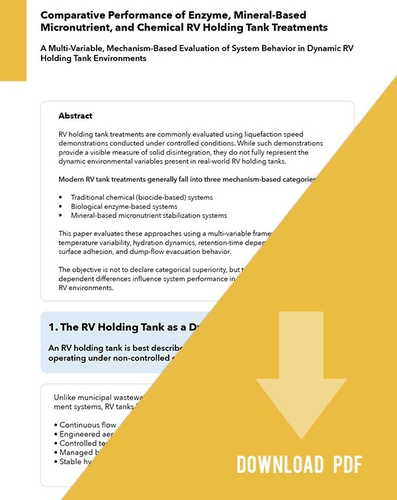
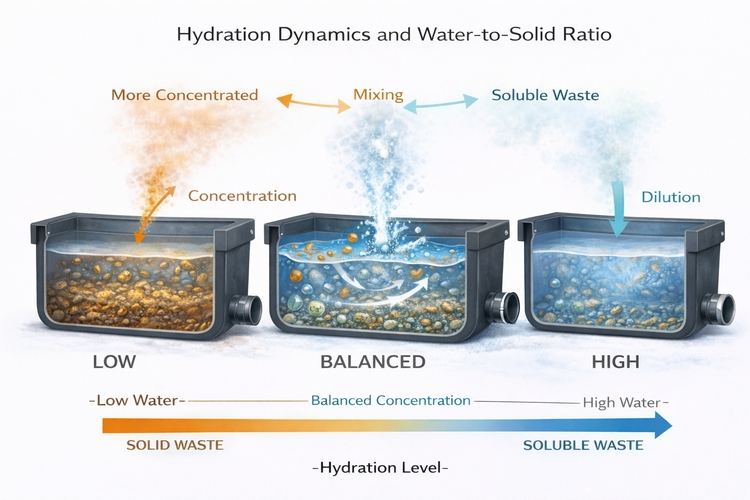
This science-based whitepaper explains how enzyme, mineral-based micronutrient, and traditional chemical RV holding tank treatments behave inside real-world RV tank conditions. It is designed for RV owners, technicians, and service professionals who want a mechanism-level understanding of why treatments perform differently across heat, low water, dump-cycle resets, and storage. Download the Whitepaper (PDF) → Format: PDF | Intended for research, education, and mechanism-based comparison. Jar tests measure how quickly paper breaks down under controlled conditions. RV holding tanks are dynamic environments: temperature swings, low-water periods, intermittent dumping, soaps and chemicals, and storage intervals all change system behavior. This whitepaper uses a mechanism-based framework to evaluate performance beyond digestion speed: system stability, odor compound volatility, dump flow, and residue formation. RV holding tanks are dynamic systems influenced by temperature fluctuation, hydration variability, retention time, and dump-cycle resets. Treatment performance often reflects environmental sensitivity rather than simple liquefaction speed. The comparison below summarizes mechanism-level differences between biological enzyme/probiotic systems and mineral-based micronutrient stabilization approaches. In dynamic RV tank environments characterized by temperature swings, variable hydration, and intermittent dump cycles, performance differences often reflect environmental sensitivity rather than digestion speed alone. Mechanism — not packaging format or marketing terminology — is the primary determinant of system stability. This video explains the real mechanics inside your RV black tank—and how different treatment approaches impact long-term results. Online marketplaces often group treatments by format rather than mechanism. These labels can be useful for convenience, but they don’t reliably predict how a treatment behaves inside a holding tank. This study classifies treatments by how they function: biological digestion vs mineral-based micronutrient stabilization (with a brief note on legacy chemical systems). Many enzyme/probiotic systems show peak functional efficiency in the approximate range of 75–90°F. Above roughly 90–95°F, performance can taper due to environmental stress and shifting tank conditions. Below about 60°F, biological activity slows significantly. RV tanks routinely experience wide swings across these ranges. This is one reason real-world performance can differ from jar demonstrations. Hydration is one of the most important variables in RV holding tanks. Low water increases viscosity and compaction, reduces diffusion, and can limit enzyme mobility and microbial transport. Heat accelerates moisture loss, creating a compounding effect: heat → dehydration → reduced mobility → reduced biological efficiency. The full PDF includes mechanism diagrams, temperature and retention curves, dump flow visuals, and an environmental dependency matrix comparing enzyme-based and mineral-based micronutrient treatment approaches. Tip: If you’re comparing products online, focus on mechanism and environmental sensitivity, not just jar demonstrations.Enzyme, Mineral-Based Micronutrient & Chemical RV Holding Tank Treatments
Why “Liquefaction Speed” Doesn’t Fully Predict Real RV Tank Performance
Environmental Sensitivity Comparison
Performance Variable
Enzyme / Probiotic Systems
Mineral-Based Micronutrient Systems
Temperature Stability
Peak functional efficiency often occurs within moderate ranges (~75–90°F). Performance may taper in elevated heat and slow significantly in colder conditions.
Not dependent on microbial growth curves or metabolic replication cycles. Performance not governed by biological temperature optima.
Hydration Dependency
Requires adequate water for enzyme mobility, substrate diffusion, and microbial transport. Reduced hydration can increase viscosity and limit effective contact.
Less dependent on aqueous diffusion for functional effectiveness. Not reliant on microbial movement within the tank environment.
Retention Time / Dump Cycles
Biological replication and digestion processes may be interrupted by frequent tank dumping and system resets.
Not dependent on population growth phases or replication cycles between dumps.
Gas Formation Dynamics
Biological digestion may produce intermediate volatile compounds during breakdown (e.g., hydrogen sulfide, ammonia, volatile fatty acids).
Focused on physicochemical stabilization and odor-binding mechanisms rather than metabolic digestion pathways.
Evacuation & Residue Behavior
Emphasis often placed on rapid liquefaction. Surface film and residue control may vary depending on tank conditions.
Emphasis placed on environmental stabilization and consistent evacuation behavior across variable tank conditions.
Struggling with odors, buildup, or inconsistent tank performance?
“Probiotic”, “Drop-In”, “Liquid”, “Powder” — What Those Labels Actually Mean
Why Heat Can Reduce Biological Consistency
Water-to-Solid Ratio, Viscosity, and Enzyme Mobility
What This Study Helps You Evaluate
Download the Full Technical Whitepaper
From Mechanism to Real-World Performance
This whitepaper outlines how different RV holding tank treatment mechanisms respond to temperature variability, hydration shifts, and retention-time cycles. For RV owners seeking a mineral-based stabilization approach engineered for environmental consistency, you can explore our treatment options below.
faqsplity
Frequently Asked Questions
What is this whitepaper about?
It’s a mechanism-based comparison of enzyme, mineral-based micronutrient, and traditional chemical RV holding tank treatments, focused on real-world performance variables like temperature, hydration, dump cycles, and evacuation behavior.
Does the whitepaper claim one system is universally “best”?
No. It explains how different mechanisms behave under different conditions so RV owners can evaluate effectiveness based on climate, water use, and dump intervals.
Why don’t jar tests tell the whole story?
Jar tests measure solid disintegration under controlled conditions. They do not replicate dump-cycle resets, temperature swings, low-water viscosity changes, chemical exposure, or gas-phase volatility dynamics.
What does “mineral-based micronutrient” mean?
It refers to non-biological treatment approaches that operate through physicochemical interactions rather than microbial replication or enzyme digestion cycles.
What do terms like “drop-in” and “liquid” mean?
Those terms usually describe format or packaging. A drop-in can be enzyme-based or mineral-based. A liquid can contain enzymes, bacteria, surfactants, or deodorants. Mechanism is a better predictor of environmental sensitivity than format alone.
Where can I download the PDF?
Use the download buttons on this page. Download the whitepaper here →
RV Holding Tank Treatment Performance: A Mechanism-Based Analysis
This 5-page research brief summarizes a mechanism-based framework for evaluating RV holding tank treatments under real-world conditions. The analysis examines gas formation, hydration dynamics, temperature-dependent biological activity, and dump-flow behavior in mobile wastewater systems.
Designed as a condensed overview of the full white paper, this technical brief introduces the environmental variables that influence odor control and treatment performance in RV tanks.