


RV Holding Tank Maintenance
GEO Method vs RV Holding Tank Treatments
The GEO Method is still popular with many RVers because it feels simple, affordable, and practical. But is it really enough for long-term black and gray tank care? Here’s what RV owners should know before relying on DIY tank maintenance alone.
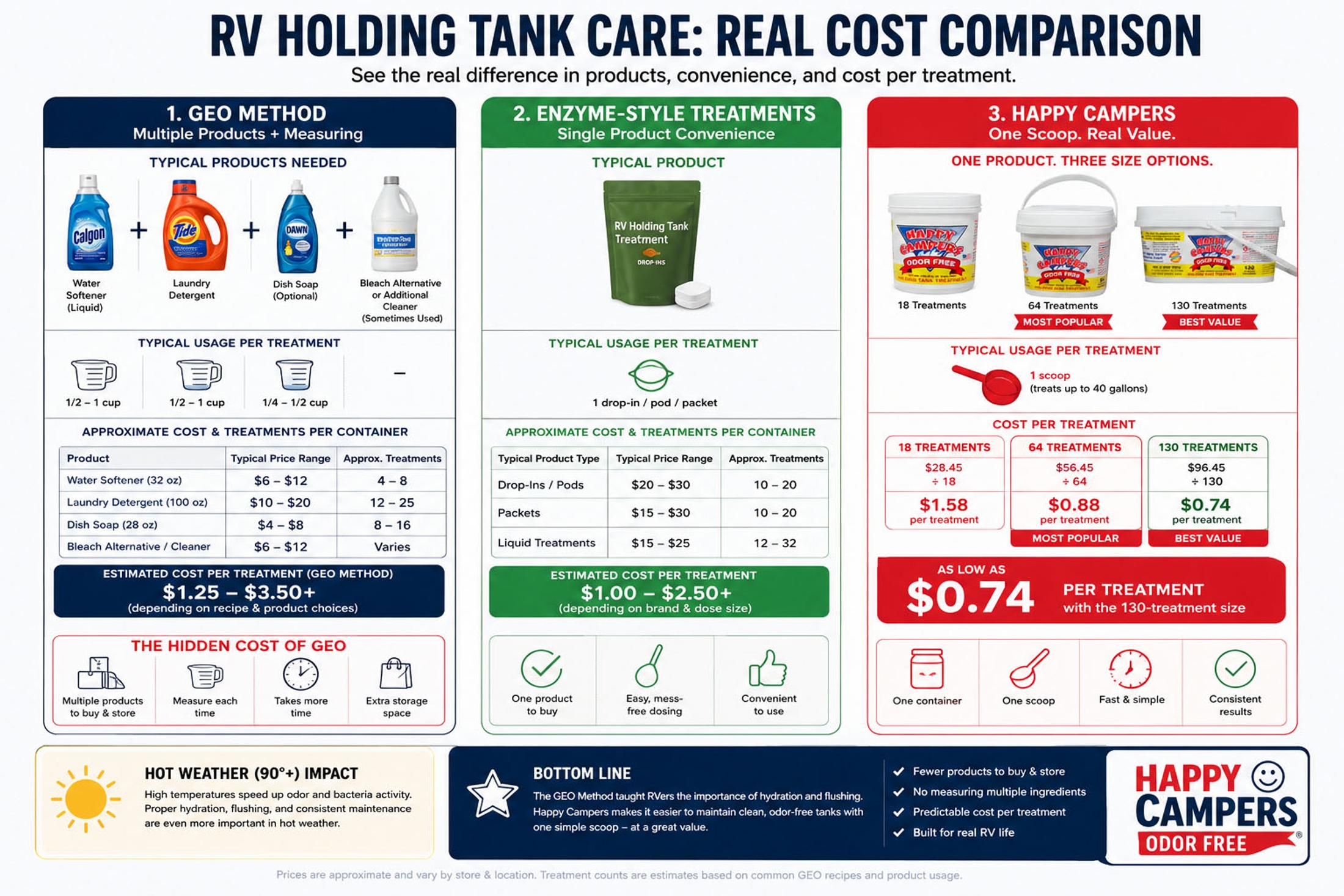

Comparison based on common RV forum GEO recipes, approximate retail pricing, and published treatment counts. Actual usage and costs vary by RV size, dumping habits, and treatment frequency.
Quick Answer: Is the GEO Method Enough?
The GEO Method can be helpful because it encourages RV owners to use plenty of water, avoid dry tanks, and think about tank maintenance instead of only masking odors. But it is not a complete solution for every RV holding tank problem.
Recurring odors, inaccurate sensors, slow drainage, gray tank smells, buildup, vent issues, and poor dumping habits often require a more complete maintenance approach than DIY ingredients alone.
What Is the GEO Method for RV Holding Tanks?
The GEO Method is a DIY RV holding tank care approach that typically uses water, water softener, detergent, and regular flushing to help reduce residue and support smoother dumping. Many RVers like it because the ingredients are easy to find and the concept is simple.
At its best, the GEO Method teaches one very important lesson: water matters. RV holding tanks need enough liquid to help suspend waste, rinse tank surfaces, and move contents out when dumping.
Why So Many RVers Like the GEO Method
The GEO Method became popular because it feels practical. In RV groups and forums, it is often recommended as a low-cost alternative to packaged holding tank treatments.
It Feels Affordable
Many RVers already have detergent or household cleaning products on hand, so the method can feel cheaper upfront.
It Encourages Water Use
Using more water is one of the best habits RV owners can build for healthier black and gray tank performance.
It Feels DIY-Friendly
Some RVers prefer making their own tank care routine instead of buying a dedicated RV holding tank product.
Where the GEO Method Falls Short
The GEO Method may help some RVers with routine rinsing and water use, but it does not diagnose or correct every tank issue. Many RV odor problems are caused by conditions that DIY ingredients cannot fix by themselves.
It Does Not Fix Poor Dumping Habits
Leaving the black tank valve open, dumping too early, or using too little water can still create buildup and odor problems.
It Does Not Deep Clean Buildup
If waste, grease, residue, or sensor film is already attached to tank surfaces, routine DIY maintenance may not be enough.
It Can Be Inconsistent
Different RVers use different ingredients, amounts, and routines, which can lead to inconsistent results.
It Adds Extra Measuring
Full-time RVers often want simple, repeatable maintenance without carrying and measuring multiple products.
It Does Not Diagnose Odors
Odors may come from the black tank, gray tank, roof vent, toilet seal, P-trap, air admittance valve, or drain lines.
It Does Not Replace a System
Tank care works best when water, dumping, flushing, treatment, and deep cleaning are used together correctly.
GEO Method vs Enzyme Treatments vs Happy Campers
Most RV holding tank advice falls into three different approaches. The GEO Method focuses on DIY water-based tank care, enzyme-style treatments focus on waste breakdown claims, and Happy Campers focuses on simple, consistent tank condition management as part of a complete maintenance routine.
GEO Method
Primary focus: Water, rinsing, detergent-style cleaning, and DIY tank maintenance habits.
Best for: RVers who like homemade routines and already understand proper water use, dumping, and flushing.
Limitation: Requires multiple ingredients, varies by recipe, and does not solve existing buildup, vent issues, sensor contamination, or poor dumping habits.
Enzyme-Style Treatments
Primary focus: Waste breakdown, liquefaction claims, and odor reduction through treatment additives.
Best for: RVers looking for a common retail treatment option with simple dosing.
Limitation: Waste breakdown alone does not correct tank buildup, poor flushing, dry tank conditions, gray tank grease, venting problems, or false sensor readings.
Happy Campers
Primary focus: Routine tank condition management through proper hydration, consistent dosing, flushing, and maintenance habits.
Best for: RVers who want a simple, repeatable scoop-and-flush routine for black and gray tank care.
Limitation: Works best as part of a complete system. Neglected tanks may still need deep cleaning before routine maintenance can perform its best.
| Category | GEO Method | Enzyme Treatments | Happy Campers |
|---|---|---|---|
| Main Philosophy | DIY water-based tank care. | Waste breakdown and odor treatment. | Tank condition management. |
| Ease of Use | Requires multiple ingredients and measuring. | Usually simple to dose. | Simple scoop-and-flush routine. |
| Consistency | Results vary by recipe, water use, and tank habits. | Results depend on tank condition, temperature, water use, and maintenance habits. | Predictable dosing for routine black and gray tank maintenance. |
| Storage | May require carrying several household products. | Usually one bottle, packet, or pod. | One container designed for RV holding tank use. |
| What It Does Well | Encourages water use, rinsing, and DIY maintenance awareness. | Provides a familiar treatment option focused on waste and odor. | Supports a simple, consistent routine built around better tank conditions. |
| What It Does Not Solve Alone | Existing buildup, vent issues, sensor contamination, gray tank grease, or poor dumping habits. | Buildup, dry tanks, bad valve habits, blocked vents, drain odors, or sensor problems. | Neglected tanks may still need corrective deep cleaning before routine maintenance. |
| Best For | RVers who prefer DIY routines and understand tank maintenance basics. | RVers shopping for common treatment products focused on waste breakdown claims. | RVers who want a simpler, repeatable maintenance process that fits real travel. |
The most effective RV holding tank maintenance routine is not just about adding a treatment. Long-term tank performance depends on hydration, flushing, dumping habits, tank cleanliness, and using a system simple enough to follow consistently.
The Real Cost of the GEO Method vs Happy Campers
The GEO Method is often recommended as the “cheap” RV holding tank solution, but the real cost is not just the ingredients. It also includes buying multiple products, carrying them in the RV, measuring each one, and repeating the process every time you treat the tank.
GEO Method
Typical setup:
Water softener + detergent + lots of water.
Hidden cost:
Multiple ingredients, extra storage, measuring, and inconsistent recipes.
What many RVers discover:
The method itself is not difficult, but repeatedly buying and carrying several household products becomes less convenient over time.
Best way to describe it:
Low-cost in theory, less convenient in real RV use.
Enzyme-Style Treatments
Typical setup:
One packet, pod, bottle dose, or drop-in.
Primary focus:
Waste breakdown and odor treatment claims.
What many RVers discover:
Convenient dosing alone does not automatically solve buildup, drainage, sensor, or venting issues.
Best way to describe it:
Simple to use, but still dependent on overall tank conditions and maintenance habits.
Happy Campers
Typical setup:
One scoop treats up to 40 gallons.
Real treatment cost:
- 18-treatment size: about $1.58 per treatment
- 64-treatment size: about $0.88 per treatment
- 130-treatment size: about $0.74 per treatment
What many RVers like:
Simple scoop-and-flush routine without measuring multiple household ingredients.
Best way to describe it:
Simple, predictable, and easy to repeat.
Typical GEO Ingredient Usage
| Product | Typical GEO Recipe Usage | Approximate Treatments |
|---|---|---|
| Liquid Water Softener | 1/2–1 cup | ~4–8 treatments |
| Laundry Detergent | 1/2–1 cup | ~12–25 treatments |
| Dish Soap (Optional) | 1/4–1/2 cup | ~8–16 treatments |
| Happy Campers | 1 scoop | 18 / 64 / 130 treatments per container |
Approximate GEO usage based on common RV forum and online recipe examples. Actual usage varies widely depending on tank size, recipe, dumping habits, and treatment frequency.
RV Tank Care in Hot Weather (90°+)
High temperatures make proper tank maintenance even more important. Heat accelerates odor formation, dries tanks faster, and can worsen buildup if tanks are not properly hydrated and flushed.
GEO Method
Can help support hydration and rinsing habits, but still depends heavily on water use and dumping practices during extreme heat.
Enzyme Treatments
Hot temperatures can affect tank conditions quickly, especially if tanks become dry, poorly flushed, or heavily coated with buildup.
Happy Campers
Designed to fit into a complete maintenance routine focused on hydration, flushing, and consistent tank care even during high-temperature RV travel.
The real question is not just “Which product is cheapest?” Long-term RV holding tank performance depends on hydration, flushing, dumping habits, tank cleanliness, and using a maintenance routine that is simple enough to follow consistently.
Why Some RVers Move Beyond the GEO Method
Many RVers start with the GEO Method because it is widely recommended in RV communities. Over time, some switch to Happy Campers because they want something simpler, easier to dose, and more consistent for regular travel.
“We used DIY tank methods for a while, but eventually wanted something simpler that didn’t require carrying and measuring multiple products.”
“Happy Campers became our go-to because it was easier to keep our tank routine consistent while traveling.”
Amazon
“The GEO Method made sense, but we liked having one product made for RV tank maintenance instead of mixing ingredients.”
The Real Problem: Most Tank Issues Are Not Just About Treatment
When RVers say a tank treatment “doesn’t work,” the real issue is often not the product or the GEO Method. The problem is usually the tank condition or maintenance routine.
Too Little Water
Dry tanks allow waste and paper to collect instead of moving out during dumping.
Poor Valve Habits
Leaving the black valve open can let liquids drain away while solids stay behind.
Hidden Buildup
Residue can attach to tank walls, outlets, sensors, and drain areas even when the tank appears to drain.
Wrong Odor Source
The smell may come from the gray tank, sink drain, vent, toilet seal, or plumbing instead of the black tank.
The Happy Campers Holding Tank Maintenance System
Instead of relying on one DIY recipe to solve every tank problem, use a complete tank care system built around proper water use, dumping habits, routine treatment, flushing, and deep cleaning when needed.
1. Use Enough Water
Water is the foundation of better black and gray tank performance.
2. Dump Correctly
Keep the black valve closed until dump time and dump black before gray.
3. Flush Regularly
Flushing helps remove loose residue and supports better sensor performance.
4. Treat Consistently
Use a repeatable maintenance treatment routine after dumping.
5. Deep Clean When Needed
Persistent odors, stuck sensors, and slow drainage may need corrective cleaning.
Not Sure If You Need Treatment or Cleaning?
If odors keep coming back, the first step is identifying the real source. Use our RV odor diagnosis guide before assuming the tank treatment is the problem.
Diagnose RV Tank Odors →Want a Simpler Alternative to DIY Tank Recipes?
Happy Campers Holding Tank Treatment is designed for RV owners who want a simple, consistent scoop-and-flush maintenance routine for black and gray holding tanks.
View RV Holding Tank Treatments →Continue Learning About RV Holding Tank Maintenance
RV Holding Tank Treatments
Learn how Happy Campers fits into routine black and gray tank maintenance.
RV Tank Smell Diagnosis Guide
Find the real source of black tank, gray tank, toilet, and drain odors.
Treatment vs Deep Cleaning
Learn when routine treatment is enough and when buildup needs corrective cleaning.
How to Dump & Flush RV Tanks
Follow the correct black and gray tank dumping and flushing process.
FAQ: GEO Method vs RV Holding Tank Treatments
Does the GEO Method work for RV holding tanks?
The GEO Method can help some RVers maintain better tank habits by encouraging water use and regular flushing. However, it does not solve every odor, buildup, sensor, vent, or drainage issue.
Is the GEO Method cheaper than RV tank treatment?
It may feel cheaper upfront, especially if you already have the ingredients. But the cost can vary depending on the products used, how often you treat, and how many separate ingredients you carry.
Is Happy Campers the same as the GEO Method?
No. Happy Campers is a dedicated RV holding tank treatment designed for simple, consistent routine dosing. The GEO Method is a DIY approach that usually requires multiple household ingredients.
Can either method fix a dirty tank?
Routine treatment and DIY maintenance may not remove heavy buildup already attached to tank walls, sensors, outlets, or drain lines. Persistent issues may require a deep cleaning process.
What is the best long-term RV tank care routine?
The best routine combines enough water, proper dumping habits, regular flushing, consistent treatment, and deep cleaning when odors, sensor issues, or slow drainage indicate buildup.