



Is Your RV Black Tank Conditioned for Performance?
Posted by Happy Campers Store on Mar 20th 2026
Is Your RV Black Tank Conditioned for Performance?
Most RV owners focus on one goal when it comes to black tank care: keeping the tank clean.
And that’s important.
But here’s what many RVers don’t realize:
A clean tank is only the starting point. A conditioned tank is what actually performs better.
If you’ve ever dealt with:
- Waste sticking inside the tank
- Inconsistent dumping
- Sensor misreadings
- Lingering odors after dumping
…then you’re not just dealing with a cleaning issue — you’re dealing with a conditioning issue.
In this guide, we’ll break down what tank conditioning really means, how it works, and how to properly condition your RV holding tank for better performance.
Do RV Black Tanks Need Treatment or Just Water?
RV black tanks need both proper water levels and a consistent treatment approach — but not for the reasons most people think.
Water is essential because it:
- Keeps waste suspended instead of stacking
- Helps prevent clogs and “pyramid” buildup
- Provides the primary transport mechanism during dumping
Without enough water, even the best tank treatment won’t prevent problems.
However, water alone does not control how waste interacts with tank surfaces.
This is where a mineral treatment plays an important role.
A properly chosen tank treatment helps support:
- Reduced surface adhesion (less sticking to tank walls)
- More consistent waste suspension
- Improved flow during dumping
- More stable tank conditions between cleanings
The key difference is this:
- Water enables movement
- Treatment helps control how waste behaves
The best results come from using both together — not relying on one or the other.
Rather than thinking in terms of “breaking waste down faster,” it’s more accurate to think in terms of maintaining a tank environment where waste stays mobile, doesn’t stick, and evacuates consistently.
Water moves waste. Conditioning controls how it moves.
What Is RV Tank Conditioning?
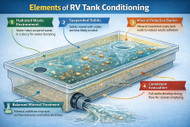
RV tank conditioning is the process of maintaining a stable internal environment inside your holding tank that supports proper waste suspension, reduces surface adhesion, and allows for consistent, complete dumping.
It goes beyond basic cleaning.
While cleaning removes buildup, conditioning focuses on how waste behaves inside the tank during use.
A properly conditioned RV tank is:
- Hydrated with sufficient liquid
- Maintained with consistent treatment
- Less prone to waste sticking to walls or sensors
- Optimized for smooth evacuation when dumping
Tank conditioning is not the same as deodorizing or deep cleaning.
It does not require harsh chemical flushes or household cleaners. Instead, it relies on maintaining proper water levels, consistent usage habits, and a stable internal environment.
Cleaning removes buildup. Conditioning controls performance.
Why Cleaning Alone Isn’t Enough
Cleaning your tank removes buildup — and that’s essential.
But cleaning alone does not control how waste behaves the next time you use your tank.
Once the tank is emptied and rinsed, the system resets.
From that point forward, performance depends on:
- Water levels
- Waste suspension
- Surface interaction
- Flow dynamics during dumping
This is why two RVers can have equally “clean” tanks — but completely different results when they dump.
The difference is conditioning.
Common Misconceptions About RV Tank Conditioning
Myth: Tank conditioning means using enzyme cleaners to break down waste.
Reality: Breaking down waste is only one part of tank function. Conditioning focuses on suspension, surface interaction, and flow behavior.
Myth: You need harsh cleaners like Pine-Sol or detergent mixes.
Reality: Household cleaners are not designed for RV systems and do not improve tank performance. Conditioning is achieved through proper water use and consistent tank treatment.
Myth: Conditioning and cleaning are the same thing.
Reality: Cleaning removes buildup. Conditioning controls how the system performs between cleanings.
What Happens Inside an Unconditioned Tank
When a tank is clean but not properly conditioned, several issues can develop:
- Solids begin sticking directly to tank walls
- Toilet paper can bridge across surfaces
- Waste can stack beneath the toilet opening
- Flow becomes inconsistent during dumping
This is often the beginning of problems like:
Even though the tank may have been recently cleaned, the system is not optimized for performance.
What a Properly Conditioned Tank Looks Like
In a conditioned tank, waste behaves differently.
Instead of sticking, waste remains:
- Suspended in liquid
- Free-moving
- Less likely to adhere to surfaces
This leads to:
- More complete tank evacuation
- Reduced buildup over time
- Improved sensor reliability
- More predictable performance
This is the goal of proper tank care — not just cleanliness, but consistent internal behavior.
How Do You Condition an RV Black Tank?
Tank conditioning isn’t complicated, but it does require consistency.
1. Start With Water After Every Dump
Always add water back into the tank after dumping.
This creates a liquid base that prevents early waste from sticking to dry surfaces.
2. Maintain a Liquid-Dominant Environment
Waste should remain suspended, not stacked.
If waste isn’t floating, it’s more likely to stick.
3. Use a Consistent Tank Treatment Approach
Tank treatments can influence how waste interacts with surfaces.
Some systems rely on biological processes, while others use mineral-based chemistry to influence surface behavior and suspension.
The key is consistency — maintaining a stable environment inside the tank.
4. Dump at the Right Time
A fuller tank creates stronger flow during dumping, improving evacuation.
Learn more here: How Often Should You Dump Your RV Black Tank?
5. Rinse — But Don’t Over-Strip the System
Rinsing is important, especially when buildup is present.
But the goal isn’t to create a perfectly sterile tank every time.
The goal is to maintain a balanced, functional system.
Is Tank Conditioning a Real Thing?
Yes — although most RVers don’t use that term.
In practice, experienced RV owners already understand conditioning through habits like:
- Adding water after dumping
- Avoiding early dumping
- Using consistent treatment methods
- Maintaining proper tank hydration
What’s often missing is the explanation of why these habits work.
They work because they influence the internal conditions of the tank — not just its cleanliness.
Do Enzyme or Bacterial Treatments “Condition” Your Tank?
This is a common question.
Some treatments rely on enzymes to break down waste.
These systems focus primarily on digestion.
However, digestion alone does not always control:
- Surface adhesion
- Wall buildup behavior
- Flow consistency during dumping
Other treatment approaches focus more on influencing the physical behavior of waste inside the tank.
These approaches can help support:
- Suspension
- Reduced sticking
- More consistent evacuation
Ultimately, conditioning is about the overall system environment, not just how quickly waste breaks down.
How Mineral-Based Treatments Support Tank Conditioning
Not all RV tank treatments are designed with conditioning in mind.
Different treatment approaches focus on different aspects of tank performance.
Many products on the market are built around biological processes — using bacteria or enzymes to break down waste over time.
While digestion can play a role in reducing solids, it does not directly control how waste interacts with tank surfaces during normal use.
This is where conditioning-focused approaches differ.
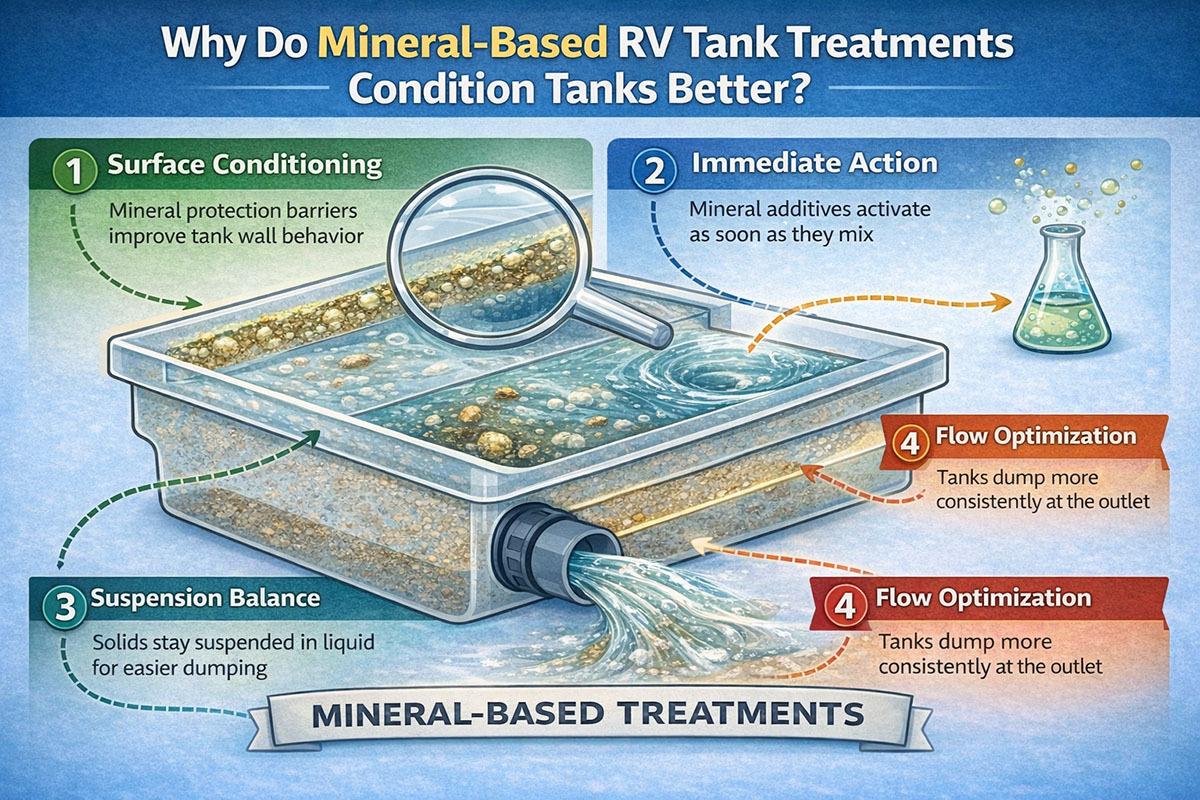
Mineral-based treatments are designed to influence the physical behavior of waste inside the tank, including:
- Surface interaction with tank walls
- Suspension of solids in liquid
- Reduction of adhesion tendencies
- Consistency of flow during dumping
Rather than relying on microbial activity, these systems work through physicochemical interactions within the tank environment.
This can help support a more stable internal condition — especially in real-world RV use where:
- Temperature varies widely
- Retention times are inconsistent
- Water usage fluctuates
Because conditioning is largely about how waste behaves before and during dumping, approaches that influence surface interaction and suspension can play an important role in maintaining performance.
In other words, conditioning isn’t just about breaking waste down — it’s about how easily it moves.
What Tank Conditioning Does NOT Mean
To avoid confusion, let’s be clear.
Tank conditioning does NOT mean:
- Letting waste build up
- Skipping rinsing
- Ignoring maintenance
- Allowing sludge to accumulate
Cleaning is still essential.
Conditioning builds on top of proper cleaning — it does not replace it.
Final Thoughts: Clean + Conditioned = Best Performance
RV black tank performance isn’t just about how clean the tank looks.
It’s about how the system behaves inside.
The best-performing tanks are:
- Properly cleaned when needed
- Consistently hydrated
- Maintained with stable internal conditions
- Conditioned for predictable performance
A clean tank is the foundation. A conditioned tank is what keeps it working.
Understanding this difference can help you avoid common RV tank problems — and make your entire system easier to manage over time.