



RV Battery Replacement Guide (6V vs 12V vs Lithium)
Posted by Happy Campers Store on Jan 30th 2026
RV Battery Replacement Guide (6V vs 12V vs Lithium)
Replacing your RV batteries isn’t just about swapping old ones — it’s about choosing the right battery type for how you actually camp, how much power you use, and how your RV’s electrical system is designed to operate. The wrong battery choice can lead to poor performance, electrical damage, premature failures, and ongoing frustration when camping off-grid.
This guide explains how 12-volt, 6-volt, and lithium RV batteries differ, how they interact with converters, inverters, and shore power, and how to choose the best option for reliability, safety, and long-term cost.
Which RV Battery Type Is Best?
Quick answer:
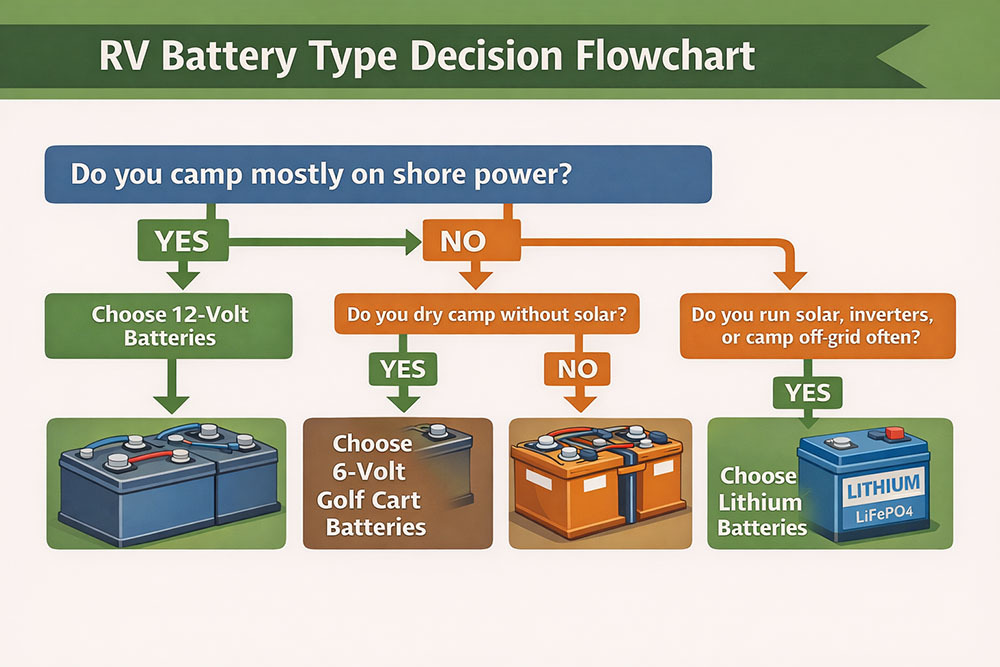
- 12-volt RV batteries are best for occasional camping and shore-power use.
- 6-volt RV batteries are best for frequent dry camping where durability matters.
- Lithium RV batteries (LiFePO₄) are best for solar setups, inverter use, and full-time RVing.
The best RV battery depends on how often you camp off-grid, how much electricity you consume overnight, and whether your RV’s charging equipment is compatible with advanced battery chemistry.
RV Battery Type Decision Flowchart
12-Volt RV Batteries Explained
12-volt batteries are the most common battery type found in RVs, especially travel trailers, pop-ups, and motorhomes that spend most of their time connected to shore power. They are popular because they are inexpensive, widely available, and easy to install as a direct replacement for factory batteries.
From an electrical standpoint, 12-volt lead-acid batteries are simple but limited. While a battery may be rated for 100 amp-hours on paper, only about 50% of that capacity is safely usable. Discharging below this level accelerates sulfation, a chemical process that permanently reduces battery capacity and shortens lifespan. This is why many RVers feel like their batteries “suddenly died” after a few seasons.
Another limitation of 12-volt batteries is voltage sag under load. As the battery discharges, voltage drops quickly. This causes lights to dim, fans to slow, and control boards to behave erratically even when there is still capacity remaining. Appliances that rely on stable voltage, such as furnaces and refrigerators, are often the first to show problems.
12-volt batteries perform best when they are kept fully charged. RVs that remain plugged into shore power benefit from the converter maintaining battery voltage, which masks many of the weaknesses of lead-acid chemistry. This is why 12-volt batteries work well for campground-based camping but often disappoint during dry camping.
Maintenance is another consideration. Flooded 12-volt batteries require regular inspection, watering, and terminal cleaning. Neglecting these tasks leads to corrosion, reduced charging efficiency, and heat buildup at the terminals. AGM versions reduce maintenance but still share the same depth-of-discharge limitations.
In short, 12-volt RV batteries are best suited for light electrical loads, short off-grid stays, and RVs that spend most nights plugged in. They are affordable and simple, but they are not designed for heavy inverter use or extended boondocking. Understanding these limits prevents unrealistic expectations and unnecessary upgrades.
Top Recommended 12-Volt RV Battery
For RVers who camp mostly on shore power and want a reliable, maintenance-friendly house battery with excellent reviews and long life, this option is consistently recommended by owners and experts.
View LiTime 12V 100Ah Deep Cycle Battery*Highly rated lithium option with built-in protection and excellent cycle life — a strong choice for RV house battery replacement.*
6-Volt RV Batteries Explained (Golf Cart Batteries)
6-volt RV batteries, commonly called golf cart batteries, are favored by RVers who dry camp frequently and want longer battery life without moving to lithium. Unlike 12-volt batteries, 6-volt batteries are designed from the start for deep-cycle use, meaning they tolerate repeated discharge and recharge cycles far better.
Because a single 6-volt battery does not provide enough voltage for an RV electrical system, they are always wired in series. Two 6-volt batteries connected in series produce the required 12 volts while maintaining the same amp-hour capacity. This wiring configuration is critical; incorrect wiring is one of the most common causes of poor performance and premature battery failure.
The main advantage of 6-volt batteries lies in their internal construction. They typically use thicker lead plates than 12-volt batteries, which makes them more resistant to sulfation and physical degradation. This allows them to handle deeper discharge cycles more consistently, often delivering a noticeably longer service life under similar conditions.
Voltage stability is another benefit. While 6-volt batteries still experience voltage drop as they discharge, the effect is usually more gradual than with 12-volt batteries. RVers often notice steadier lighting, more reliable furnace operation, and fewer low-voltage errors when running similar loads.
There are tradeoffs. 6-volt batteries are heavier, larger, and require more space in the battery compartment. They also do not increase usable capacity beyond the same 50% rule that applies to lead-acid chemistry. Like 12-volt flooded batteries, they require regular maintenance, including watering and terminal cleaning.
6-volt batteries are best suited for frequent dry camping, extended weekends off-grid, and RVers who want durability without upgrading charging equipment. They offer a meaningful performance upgrade over 12-volt batteries, but they are not ideal for heavy inverter use or long-term off-grid power without solar support.
Recommended 6-Volt RV Battery (Maintenance-Free AGM)
For RVers who want the durability of a 6-volt golf cart battery without the maintenance of flooded lead-acid cells, this AGM option is a strong choice. It is frequently recommended by RV owners who dry camp regularly but prefer a sealed, no-watering battery design.
- True 6-volt deep-cycle AGM battery (GC2 size)
- High 225Ah capacity for series-wired RV battery banks
- Maintenance-free, sealed design (no watering or off-gassing)
- Performs well in dry camping and solar-assisted setups
*Best suited for frequent dry camping, sealed battery compartments, and RVers who want a low-maintenance 6-volt setup.*
Lithium RV Batteries Explained (LiFePO₄)
Lithium RV batteries, specifically lithium iron phosphate (LiFePO₄), represent a major shift from traditional lead-acid battery technology. Unlike 12-volt and 6-volt lead-acid batteries, lithium batteries maintain a nearly flat voltage curve throughout most of their discharge cycle. This means appliances receive consistent voltage until the battery is nearly depleted, rather than slowly losing performance as the battery drains.
One of the biggest advantages of lithium batteries is usable capacity. While lead-acid batteries should only be discharged to about 50% to avoid damage, lithium batteries can safely use 80–100% of their rated capacity. In real-world use, this often means a single lithium battery can replace two or more lead-acid batteries while delivering better performance.
Lithium batteries also excel under heavy electrical loads. Inverter-powered appliances such as microwaves, coffee makers, and induction cooktops draw large amounts of current. Lead-acid batteries experience rapid voltage drop under these loads, causing inverters to shut down early. Lithium batteries deliver stable voltage under high demand, making them the preferred choice for inverter use and solar-based systems.
Charging behavior is where many RVers run into trouble. Lithium batteries require a different charging profile than lead-acid batteries. Using a standard RV converter designed for lead-acid batteries often results in incomplete charging or long-term degradation. While many lithium batteries advertise themselves as “drop-in replacements,” proper charging equipment is critical for achieving their full lifespan and performance.
Cold weather operation is another area of confusion. Lithium batteries can safely discharge below freezing, but most should not be charged below approximately 32°F unless they include built-in heating or temperature protection. Charging lithium batteries below freezing can cause permanent internal damage. This limitation is often misunderstood and is responsible for many reports of lithium batteries “not working” in winter conditions.
Lithium batteries are best suited for solar-equipped RVs, full-time RVers, and campers who rely heavily on inverters or extended off-grid power. While the upfront cost is higher, their long lifespan, low maintenance, and superior performance often make them the most cost-effective option over time when installed correctly.
Recommended Lithium RV Battery (Compact, Smart LiFePO₄)
For RVers looking to upgrade to lithium without building a large battery bank, this compact LiFePO₄ battery is a practical and well-reviewed option. It is commonly chosen for smaller RVs, weekend dry camping, and applications where space, weight, and monitoring matter.
- True LiFePO₄ chemistry with stable voltage output
- 60Ah usable capacity with deep discharge capability
- Built-in Bluetooth monitoring via smartphone app
- Lightweight and easy to fit in tight battery compartments
Unlike traditional lead-acid batteries, this lithium battery delivers consistent voltage under load, allowing lights, fans, and control systems to perform reliably until the battery is nearly depleted. The integrated Bluetooth monitoring makes it easy to track state of charge, voltage, and system health without additional hardware.
View Ionic Lithium 12V 60Ah Battery*Best suited for smaller RVs, limited battery compartments, and RVers who want lithium performance with built-in monitoring.*
How Many Batteries Does an RV Need?
There is no universal battery count for all RVs. Battery quantity depends on your RV size, electrical load, and how long you want to operate without external power.
- Small travel trailers: 1–2 batteries for lights, water pump, and control boards
- Weekend camping: 2 batteries recommended for overnight comfort
- Dry camping: 2–4 batteries depending on usage
- Solar or inverter setups: Lithium batteries strongly recommended
Many RVers assume adding batteries automatically increases performance. In reality, adding capacity without upgrading wiring, fusing, or charging equipment can create voltage drop, overheating, or uneven charging that shortens battery life.
Battery banks should be sized based on realistic overnight usage — lights, furnace fan, water pump, and refrigerator controls — not just advertised amp-hour ratings.
What Size RV Battery Should You Buy?
RV batteries are commonly classified by group size, which determines their physical dimensions, weight, and typical capacity. Choosing the correct size ensures proper fit and safe mounting.
- Group 24: Compact and lightweight, lowest capacity
- Group 27: Most common RV battery size
- Group 31: Higher capacity, heavier, requires stronger trays
Always confirm your battery tray dimensions and weight limits before upgrading. Heavier batteries may require upgraded trays, tie-downs, or cabling to prevent movement during travel.
Physical fit matters just as much as electrical capacity. Batteries that shift or vibrate excessively can damage terminals, cables, and nearby components.
RV Converter Compatibility by Battery Type
Your RV converter controls how batteries are charged whenever you’re plugged into shore power or running a generator. Battery chemistry and converter charging profiles must be compatible for safe, long-term operation.
✔ Compatible with most factory converters
✔ No upgrades required
✔ Compatible with most converters
⚠ Requires correct series wiring
⚠ Requires lithium-compatible converter
⚠ Incorrect charging shortens lifespan
Lithium batteries require precise voltage control. Using a lead-acid converter can prevent full charging or cause long-term degradation.
Learn more about converter upgrades here: How to Replace an RV Converter
Inverter Compatibility by Battery Type
Inverters convert battery power into household AC electricity. Battery chemistry dramatically affects how well an inverter performs under load.
✔ Light inverter use only
✖ Voltage sag under load
✔ Moderate inverter loads
✔ More stable voltage than 12V
✔ Best for inverter use
✔ Stable voltage under heavy loads
Voltage stability matters more than raw capacity when running appliances like microwaves or coffee makers. This is where lithium batteries excel.
How RV Batteries Interact With Your Electrical System
RV batteries do not operate in isolation. Every battery upgrade directly affects the performance and safety of your converter, inverter, shore power connection, and downstream electrical components. Many battery-related complaints are not caused by the battery itself, but by how the battery interacts with the rest of the system.
When connected to shore power or a generator, your RV converter supplies DC power to your appliances and charges the batteries. If battery chemistry and converter charging profile are mismatched, problems arise. Lead-acid batteries tolerate imprecise charging but suffer long-term capacity loss. Lithium batteries, on the other hand, require precise voltage regulation. Using an incompatible converter can result in incomplete charging, excessive heat, or shortened battery life.
Inverter behavior is also strongly influenced by battery type. Inverters draw large bursts of current, especially when starting appliances. Lead-acid batteries experience voltage sag during these surges, which can cause inverters to shut down even when the battery is not fully depleted. Lithium batteries maintain stable voltage under load, allowing inverters to run longer and more reliably.
Shore power connections are another critical factor. Higher-capacity battery banks demand higher charging current. If the shore power plug, pedestal connection, or internal wiring is worn or undersized, the increased load can lead to overheating and plug damage. This is a common cause of burned RV shore power plugs after battery upgrades.
Battery upgrades can also expose underlying electrical weaknesses. Slide-outs, jacks, and leveling systems often share power paths with the battery bank. Increased demand or voltage instability can cause these components to slow down, stall, or behave erratically. These symptoms are often misdiagnosed as mechanical failures when the root cause is electrical.
Proper system integration is essential. Upgrading batteries should be accompanied by inspection of cables, fuses, grounding points, surge protection, and charging equipment. Treating the battery as part of a complete electrical system — rather than a standalone component — prevents cascading failures and ensures long-term reliability.
Common RV Battery Replacement Mistakes
- Mixing old and new batteries in the same bank
- Mixing battery types or brands
- Incorrect 6-volt series wiring
- Ignoring converter compatibility
- Upgrading batteries without surge protection
Battery upgrades increase electrical demand. Without proper surge protection and wiring, this added demand can contribute to failures such as burned shore power plugs, converter damage, and slide-out malfunctions.
When Should You Replace Your RV Batteries?
Most RV batteries last 2–6 years depending on chemistry, usage, and charging habits.
- Batteries won’t hold a charge overnight
- Lights dim quickly when unplugged
- Slides or jacks slow down
- Voltage drops below 12.0V under light load
- Visible bulging, leaking, or corrosion
If your RV performs normally on shore power but struggles off-grid, battery capacity loss is usually the cause.
RV Battery Cost Comparison (Long-Term)
Upfront price doesn’t tell the full story. Long-term ownership cost is often lower with higher-quality batteries.
- Lead-acid batteries often require replacement every 3–4 years
- 6-volt batteries last longer but still require multiple replacements
- One lithium battery can replace multiple lead-acid cycles over 10+ years
When replacement frequency and downtime are considered, lithium often becomes the more economical option.
RV Battery Maintenance by Type
- Flooded lead-acid: Regular watering and terminal cleaning
- AGM: Minimal maintenance, sensitive to overcharging
- Lithium: No watering; monitor charging temperature
Lithium batteries should not be charged below freezing unless equipped with internal heating, though they can safely discharge at lower temperatures.
RV Battery Replacement Safety Tips
- Disconnect shore power and inverters before starting
- Remove the negative cable first
- Wear gloves and eye protection
- Secure batteries to prevent movement
- Vent flooded batteries properly
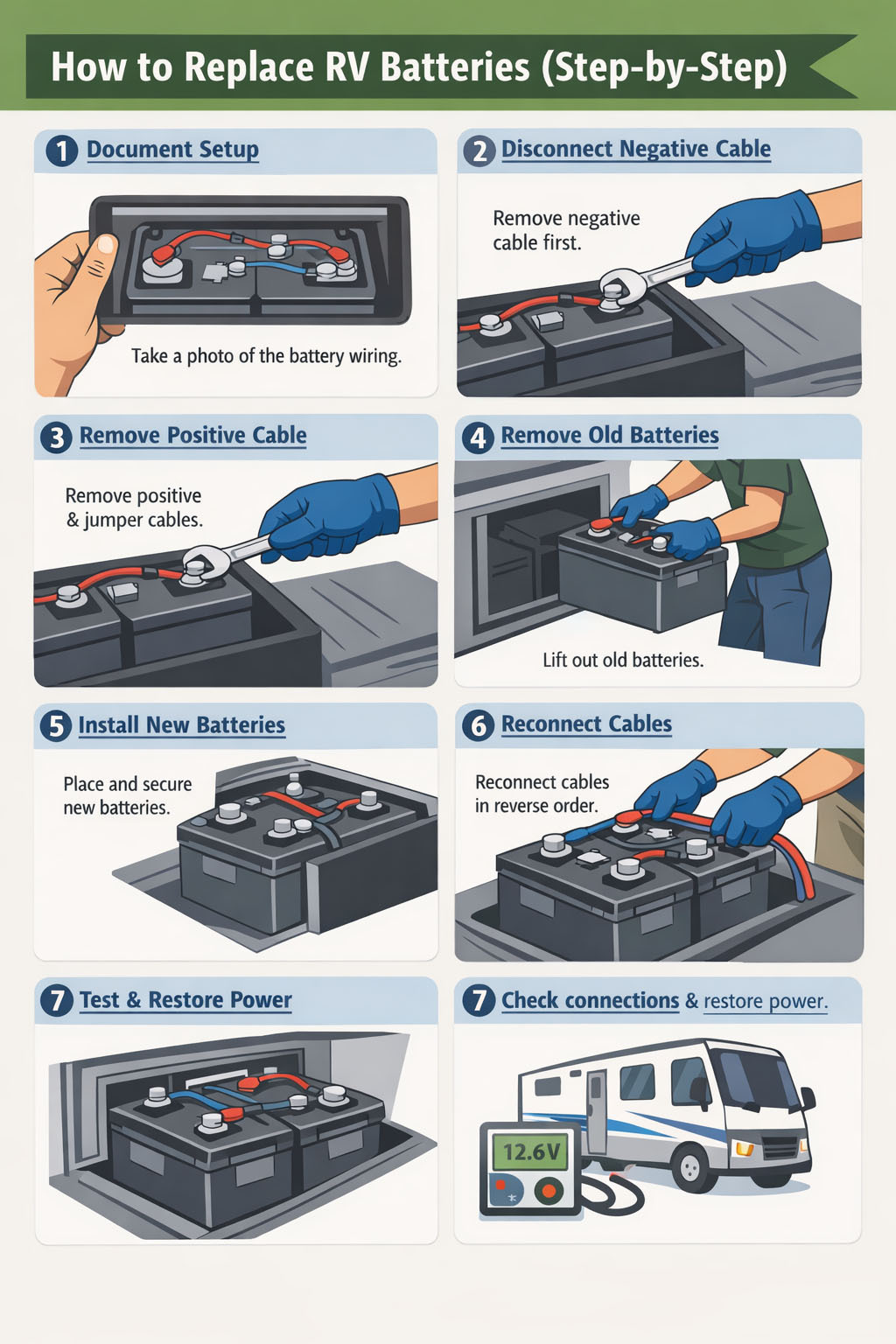
How to Replace RV Batteries (Step-by-Step)
Replacing RV batteries is a task many RV owners can safely handle themselves, provided it is done carefully and in the correct order. Most problems occur when batteries are removed or connected incorrectly, not because the task itself is complicated.
Before starting, make sure the RV is completely disconnected from all power sources. Unplug shore power, turn off the generator, and disable any inverters. This prevents unexpected electrical flow while working with battery cables.
Step 1: Document your existing setup.
Take a photo of the battery wiring before disconnecting anything. This is especially important if you are working with multiple batteries or 6-volt batteries wired in series. Photos eliminate guesswork during reinstallation.
Step 2: Disconnect the negative cable first.
Always remove the negative (ground) cable before the positive cable. This reduces the risk of accidental short circuits if a tool contacts metal while working on the positive terminal.
Step 3: Remove the positive cable and any jumper cables.
Once the negative cable is safely disconnected, remove the positive cable and any interconnecting cables between batteries. Keep cables separated to prevent accidental contact.
Step 4: Remove old batteries and inspect the compartment.
Carefully lift out the old batteries. Clean the battery tray, inspect for corrosion, and check that venting is adequate. Battery compartments should be dry, secure, and free of debris.
Step 5: Install new batteries and secure them.
Place the new batteries in the compartment and secure them using the factory hold-down system. Batteries must not be able to shift while the RV is in motion.
Step 6: Reconnect wiring in reverse order.
Reconnect the positive cable first, followed by any series or parallel jumpers. Reconnect the negative cable last. This sequence minimizes the risk of short circuits.
Step 7: Verify connections and restore power.
Double-check that all terminals are tight and properly oriented. Restore shore power or turn on the inverter and verify normal operation. Monitor battery voltage during the first charging cycle.
After installation, monitor battery behavior over the next few trips. Unusual heating, odor, or voltage irregularities indicate wiring or charging issues that should be addressed immediately.
Final Thoughts: Replace Smart, Not Cheap
Your RV batteries influence every electrical system onboard. Choosing the right battery type improves reliability, protects expensive components, and prevents many common RV electrical failures.
Related RV Electrical Guides