



RV Black Tank Clog vs Compacted Tank: Why the Fix Isn’t the Same
Posted by Happy Campers Store on Apr 7th 2026
RV Black Tank Clog vs Compacted Tank: Why the Fix Isn’t the Same
If your RV black tank is not draining properly, the problem may not be a simple clog. A localized blockage and a compacted black tank are two different problems, and treating them the same way can waste time, water, and effort.
Quick Answer
A clogged RV black tank usually means there is a localized blockage stopping waste or water from flowing out. A compacted RV black tank means you have hardened, layered buildup stuck to the tank floor, tank walls, or around the drain area that reduces capacity and prevents complete evacuation.
Back flushing can help clear a clog because it pushes water against a blockage. But back flushing usually does not remove hardened buildup that has dried, compacted, and bonded to tank surfaces over time.
In simple terms: a clog is a blockage in the flow path, while a compacted tank is a tank-wide buildup problem.
Common RV Black Tank Problems (That Aren’t Actually Clogs)
Many RV owners search for answers using symptoms — not technical terms. If you’re experiencing any of the issues below, you may not have a simple clog at all. You could be dealing with hardened waste buildup inside your black tank.
- “Why is my RV black tank not draining completely?”
- “Why does my black tank still smell after dumping?”
- “Why are my RV tank sensors always wrong?”
- “Why does my tank seem full right after I empty it?”
- “Why is my RV black tank slow to drain?”
- “Why do I keep getting buildup in my RV black tank?”
These are some of the most common RV waste tank complaints — and in many cases, they are caused by compacted, hardened residue stuck to the tank walls and floor, not a traditional clog.
That’s why understanding the difference between a clogged black tank and a compacted black tank is critical. The fix is completely different — and using the wrong approach can make the problem worse over time.
Why This Difference Matters
RV owners often use the phrase “my black tank is clogged” to describe almost any drainage problem. But that wording hides an important truth: not every slow drain, false tank reading, or persistent odor issue comes from a true clog.
Sometimes the tank outlet is obstructed by a wad of toilet paper, a pyramid plug, or other concentrated material. That is a flow problem. Other times, the tank has gradually accumulated a hard, dense layer of waste residue that is stuck to interior surfaces. That is not the same kind of problem at all.
This distinction matters because the solution changes dramatically. Forceful rinsing, reverse flushing, or aggressive water flow can be effective when you need to dislodge a blockage. But if the tank has been allowed to dry out repeatedly, run with too little water, or build up stubborn deposits over time, blasting water at it may do very little beyond making the tank temporarily wetter.
That is why so many RVers feel like they have “tried everything” and still have a black tank that drains slowly, smells bad, or seems to lose usable capacity. They may not be dealing with the wrong effort. They may be dealing with the wrong diagnosis.
Custom Diagram: Clog vs Compacted Tank
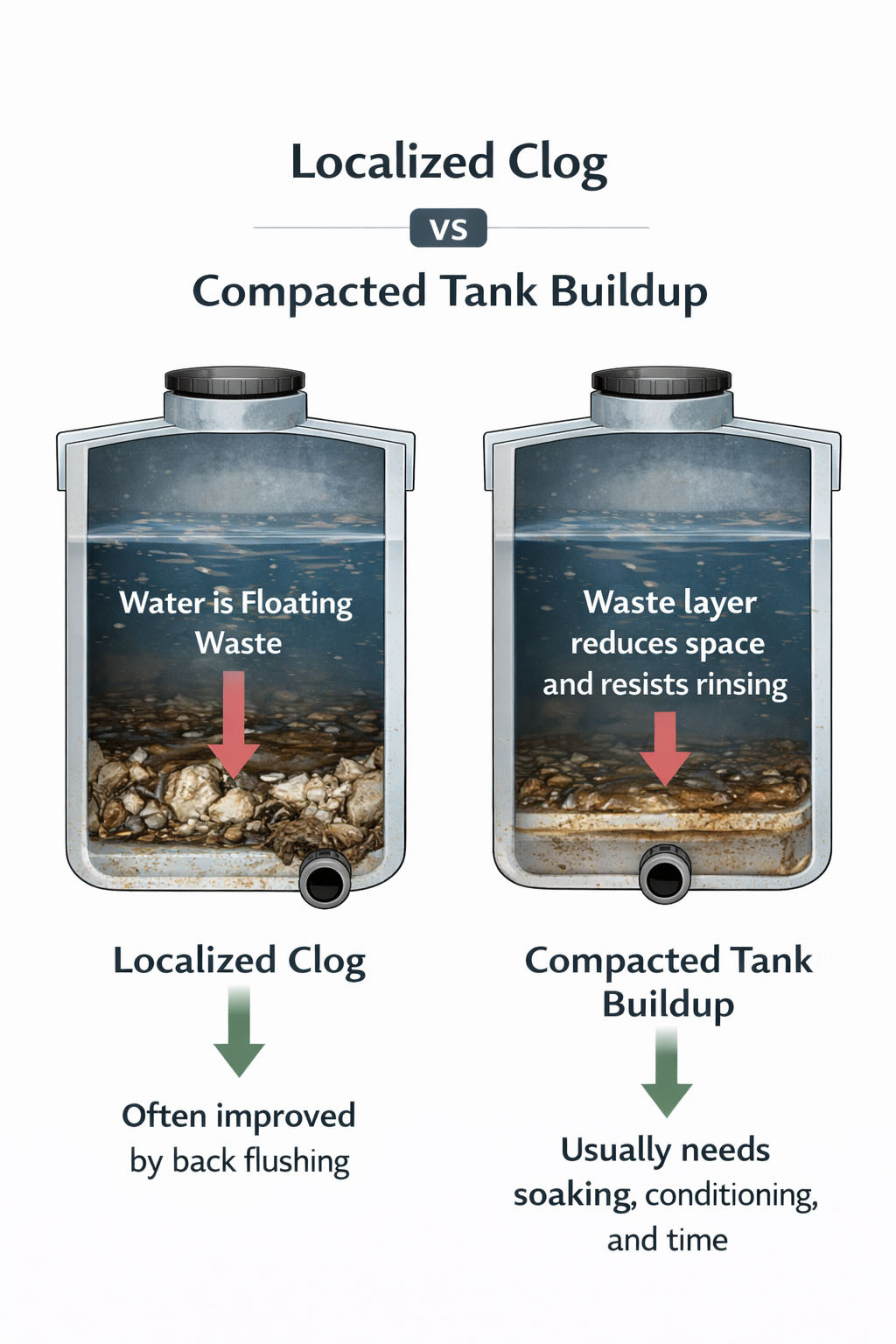
In a true clog, flow is blocked at a single point. In a compacted tank, buildup is spread across surfaces and reduces capacity even if some water can still pass through.
What Is a Clogged RV Black Tank?
A clogged RV black tank has a specific obstruction interrupting normal flow. Think of it as a bottleneck or plug. The rest of the tank may be in reasonable condition, but one concentrated mass is stopping material from moving the way it should.
This kind of problem often happens near the drain opening, directly below the toilet, or in a narrow section where paper and waste can collect. In more serious cases, a “poop pyramid” forms when solids are allowed to stack up in one area rather than staying suspended and mobile.
Common signs of a black tank clog include a sudden stop in drainage, liquid backing up into the toilet, or a situation where the tank was working normally and then abruptly was not. That sudden change is often the clue. Clogs are usually point-specific and tend to create a more immediate blockage pattern.
A clog may respond well to back flushing, tank rinsers, targeted water pressure, and mechanical agitation because the issue is concentration. You are not trying to rehabilitate the whole tank surface. You are trying to break up or move one obstructing mass.
What Is a Compacted RV Black Tank?
A compacted RV black tank is different. Instead of a single plug, you are dealing with hardened and often layered buildup spread across the tank floor, interior walls, corners, or around the outlet area. This buildup can become dense, dry, and resistant to simple rinsing.
In many cases, compaction develops gradually. The tank may still drain to some extent, which is why the problem is often missed at first. But over time, usable tank space shrinks, odors become harder to control, residue remains behind after dumping, and sensors may start giving unreliable readings.
Unlike a basic clog, compaction is more of a surface condition than a simple flow interruption. The tank interior has changed. Waste is no longer moving across relatively clean surfaces. Instead, it is interacting with residue that can trap solids, hold odor-causing material, and contribute to ongoing accumulation.
This is why a compacted tank can fool RV owners. The valve opens. Some waste exits. Water flows through. So it looks like the tank is technically draining. But it is not truly evacuating well, and each cycle leaves more material behind.
Featured Snippet Comparison Table
| Problem | What It Means | Typical Symptoms | What Usually Helps | What Usually Won’t Be Enough |
|---|---|---|---|---|
| Clogged black tank | A localized blockage or plug in the flow path | Sudden drainage stop, toilet backup, little or no outflow | Back flushing, targeted rinsing, agitation, clearing the blockage | Waiting for hardened residue to magically dissolve on its own |
| Compacted black tank | Hardened buildup stuck to tank surfaces that reduces capacity | Slow incomplete draining, odor after dumping, reduced capacity, bad sensor readings | Soaking, repeated hydration, tank conditioning, time-based loosening of buildup | Back flushing alone or one quick rinse cycle |
Why Back Flushing Helps a Clog but Often Fails on Compaction
Back flushing is a useful tool because it reverses or redirects water pressure through the tank and outlet area. That can be exactly what you want when the issue is a concentrated obstruction. A clog is something you may be able to break apart, loosen, or force out of the way with enough flow and agitation.
But compaction behaves differently. Hardened waste deposits can become dense and adhere to surfaces over repeated use cycles. Once material has dried, compressed, and layered onto the tank floor or walls, sending more water through the system does not automatically separate it from the plastic.
This is the mistake many RV owners make: they see water moving, so they assume the cleaning is working. In reality, water may simply be moving around or over the buildup instead of removing it.
A good way to think about it is this: you can push water through a compacted tank without actually restoring the tank interior. That is why a tank may seem “better” after flushing, then quickly go back to the same symptoms. The underlying residue never really left.
Here’s what a true clog looks like — and how it’s cleared:
In this case, the problem is a localized blockage near the outlet. Once the obstruction is broken up and cleared, normal flow returns — unlike a compacted tank, where buildup remains even after water flows through.
Real RV Black Tank Cleaning: What Compaction Actually Looks Like
One of the biggest misconceptions about RV black tanks is that if the water runs clear, the tank must be clean.
But as you’ve seen, compacted buildup can remain stuck to the tank walls and floor — even after rinsing and back flushing.
In this real-world example, an RV owner used an extreme black tank cleaning process and measured the results using a flow meter.
After cleaning, he recovered over 2.5 gallons of lost tank capacity — all from hidden buildup that standard rinsing didn’t remove.
⚠️ This tank looked “clean” before this process…
This is a perfect example of the difference between a tank that appears clean and one that is actually fully cleared of buildup.
If your tank has lost capacity, smells after dumping, or never seems to fully empty, you may be dealing with this exact issue.
How a Black Tank Becomes Compacted in the First Place
Compaction usually starts with poor hydration and incomplete evacuation. When too little water is used during normal toilet use, solids do not stay mobile enough to travel and disperse the way they should. Instead, they collect, thicken, and settle.
If the tank is then dumped without enough residual water left behind, the remaining waste can dry onto the tank floor. Repeat that pattern several times and you create the conditions for harder buildup. Each cycle adds a little more residue. Each partial layer gives the next layer something to stick to.
Over time, this can create a hardened bottom layer, sidewall deposits, or concentrated buildup near the outlet zone. At that point the issue is not just “waste in the tank.” It is a tank interior that is no longer conditioning, shedding, and evacuating material effectively.
This is also why the question should not only be “what breaks down waste fastest?” The more important question is often, “what helps prevent waste from drying, sticking, and accumulating into a structural problem?”
How to Tell Whether You Have a Clog or a Compacted Black Tank
Diagnosis starts with the pattern of the problem. Here is the simplest breakdown:
Signs You Likely Have a Clog
- Drainage stopped suddenly
- Little or nothing comes out when you pull the valve
- Liquid or paper backs up toward the toilet
- The issue feels concentrated and immediate
- The tank worked fine until one obvious event
Signs You Likely Have Compaction
- The tank drains, but never seems fully empty
- Capacity seems smaller than it used to be
- Odor returns quickly after dumping
- Sensors stay inaccurate or stuck
- Performance declined gradually over time
Of course, some RVs have both problems at once. A tank can develop broad compaction and also form a localized blockage near the outlet. When that happens, clearing the clog may restore some flow without solving the bigger issue of hardened buildup still coating the tank.
Custom Diagram: Why the Treatment Path Changes
The key diagnostic question is whether the failure was sudden and localized or gradual and systemic.
How to Treat a Clogged RV Black Tank
If you are dealing with a true clog, the goal is to restore flow. That usually means focusing on the obstruction itself.
- Confirm the symptoms. A sudden stoppage, no outflow, or toilet backup usually points to a clog.
- Use back flushing or a built-in rinser. This can help push water into the obstructed area and loosen the blockage.
- Add enough water to create movement. Small amounts of water often are not enough to break up a concentrated mass.
- Agitate if appropriate. In some cases, movement, rinsing cycles, or careful mechanical breakup may be needed.
- Dump again and reassess. If the blockage clears and flow returns normally, you were likely dealing with a clog rather than a full compaction issue.
The biggest mistake here is under-watering. A black tank that is too dry is much more likely to develop concentrated plugging in the first place.
How to Treat a Compacted RV Black Tank
If the tank is compacted, the goal is not just to create flow. The goal is to re-hydrate and loosen hardened residue over time so it can separate from the tank interior and evacuate more completely.
- Start with a generous amount of water. The tank needs enough liquid volume to soak and contact the buildup.
- Allow dwell time. Hardened waste layers usually do not disappear from one quick rinse. Time matters.
- Use a treatment approach aimed at conditioning, not just force. The objective is to reduce sticking, improve hydration, and help old residue release.
- Repeat the process. Severe buildup often breaks down in stages, not all at once.
- Evaluate results by performance, not just by one dump. Regained capacity, cleaner evacuation, less odor, and better sensor behavior are the real signs of improvement.
This is why compacted tanks often require patience. If the buildup formed gradually over months or years, it may take more than a single cleaning event to reverse the condition.
The Real Goal: Tank Conditioning, Not Just Tank Emptying
Many RV owners focus only on whether the valve opens and waste comes out. But a black tank can technically empty and still be in poor condition. That is where the concept of tank conditioning becomes so useful.
A well-conditioned tank interior is less likely to let material dry into stubborn layers, less likely to hold onto odor-causing residue, and more likely to evacuate thoroughly with each dump cycle. That is a different standard from simply saying, “something came out, so it must be clean.”
In other words, the best long-term strategy is not just reacting to emergencies. It is preventing the tank from becoming the kind of environment where compaction happens repeatedly.
Why So Many RV Tank Tests Miss This Difference
A lot of RV tank treatment discussions online center around one basic visual question: how fast does a product appear to break down waste in water? That can make for a dramatic demo, but it does not always answer the real-world maintenance question RV owners actually care about.
Compacted tanks are not just about loose waste floating in a container. They are about repeated dehydration, adhesion, residue layers, incomplete evacuation, and ongoing surface interaction inside the tank. A product can look impressive in a simple breakdown test and still not address the long-term issue of buildup sticking to tank surfaces.
That is why the clog-versus-compaction distinction is so useful. It moves the conversation away from oversimplified demos and back toward the real operating conditions inside an RV black tank.
How to Help Prevent Future Compaction
- Use enough water every time. Black tanks work better when solids stay hydrated and mobile.
- Never leave the black tank bone dry after dumping. Starting with water in the tank helps create a base layer instead of a dry landing zone.
- Avoid repeated underfilled use cycles. Too little water is one of the fastest ways to encourage buildup.
- Think in terms of surface management. The goal is not merely odor control, but preventing residue from sticking and accumulating.
- Pay attention to gradual performance changes. Reduced capacity and chronic false readings are often early warnings of compaction.
This preventive mindset is often what separates a tank that stays manageable from one that slowly turns into a recurring maintenance headache.
Final Takeaway
If your RV black tank is not draining, do not assume every problem is a clog. A clogged black tank and a compacted black tank may look similar at first, but they behave differently and require different treatment strategies.
A clog is usually a specific blockage that can often be cleared with back flushing, rinsing, and restoring flow. A compacted tank is a broader buildup issue caused by repeated dehydration, incomplete evacuation, and hardened residue stuck to interior surfaces.
That is why back flushing can clear a clog but still leave you with a tank that smells, reads full, drains slowly, or seems to have lost capacity. The obstruction may be gone, but the buildup remains.
The better question is not just, “How do I get the tank to drain today?” It is also, “What condition is the inside of my tank in, and what do I need to do to restore proper performance over time?”
Recommended Related Reading
FAQ: Clogged vs Compacted RV Black Tanks
Can a black tank drain and still be compacted?
Yes. A compacted tank can still allow some waste and water to pass through. That is what makes it tricky. The tank may technically drain, but still retain hardened buildup that reduces capacity and causes ongoing problems.
Will back flushing remove hardened black tank buildup?
Usually not by itself. Back flushing is most useful for localized clogs. Hardened buildup often needs soaking, repeated hydration, and a conditioning approach rather than force alone.
What causes a compacted RV black tank?
The most common causes are too little water use, leaving the tank too dry after dumping, incomplete evacuation, and repeated cycles of waste drying onto tank surfaces.
How do I know if I have a clog or a poop pyramid?
A poop pyramid is a type of localized blockage, so it behaves more like a clog. It tends to cause sudden restriction near the toilet or outlet area rather than a gradual tank-wide loss of performance.
Why does my black tank still smell after dumping?
Persistent odor after dumping can be a sign that residue remains inside the tank. That is one reason compacted buildup is often overlooked. The tank emptied partially, but not completely enough to remove the underlying source.