



RV Holding Tank Hydration: The Hidden Factor Affecting Tank Performance
Posted by Happy Campers Store on Mar 12th 2026
RV Holding Tank Hydration: The Hidden Factor Affecting Tank Performance
Many RV owners assume odors, clogs, or poor dumping performance are caused by the wrong tank treatment or plumbing issues.
But one of the most overlooked variables affecting RV holding tanks is actually hydration.
The amount of water inside an RV black tank directly affects:
- waste suspension
- odor formation
- tank evacuation efficiency
- clog formation
- sensor film
When hydration levels are wrong, even the best tank treatments may struggle to perform properly.
Understanding the fluid dynamics inside RV tanks can dramatically improve performance and prevent many common plumbing problems.
Why Water Matters in RV Black Tanks
Unlike residential plumbing systems, RV holding tanks function as closed containment vessels.
Instead of flowing continuously through pipes, waste collects in the tank until it is discharged through the dump valve.
This means solids must remain suspended in liquid in order to move efficiently during dumping.
If there is not enough water in the tank, solids can settle and compact, eventually forming clogs.
Many RV owners experiencing these issues first notice symptoms like:
- persistent sewer odors
- slow dumping
- sensor misreadings
- partial clogs
In most cases, insufficient hydration is a major contributing factor.
The Ideal RV Black Tank Water Ratio
The ideal RV black tank water ratio typically contains about 70–90% liquid so solid waste remains suspended and can flow out of the tank during dumping.
One of the most common questions RV owners ask is:
“How much water should be in an RV black tank?”
While there is no exact universal ratio, waste suspension physics suggests that a healthy tank environment typically contains:
Approximately 70–90% liquid phase
This allows solid materials to remain dispersed in liquid rather than settling into dense layers.
When liquid levels drop too low, waste viscosity increases and clogs become more likely.
What Does 70–90% Liquid Phase Actually Look Like in an RV Tank?
When experts recommend maintaining approximately 70–90% liquid phase inside an RV black tank, they are describing the physical state of the waste mixture inside the tank.
In simple terms, the tank contents should behave like a loose slurry or muddy water rather than thick sludge or compacted solids.
This allows waste particles to remain suspended in liquid so they can move freely when the tank is dumped.
Visualizing the Water-to-Solid Ratio
| Mixture Type | Approx Liquid Content | Behavior Inside Tank |
|---|---|---|
| Thick Mud | 40–50% | Barely flows, solids settle |
| Oatmeal Consistency | ~60% | Moves slowly, risk of buildup |
| Healthy RV Tank Slurry | 70–90% | Flows easily and dumps efficiently |
| Mostly Water | 95%+ | Very fluid, solids suspended |
What This Looks Like Inside a Holding Tank
The illustration below shows how hydration levels affect waste behavior inside an RV black tank.

Proper hydration keeps waste suspended in liquid, allowing the tank to empty efficiently.
Proper Hydration (70–90% Liquid)
Inside a properly hydrated tank you would typically see:
- Water covering the bottom of the tank
- Waste particles loosely suspended in liquid
- No visible mound under the toilet inlet
- Contents sloshing slightly as the RV moves
During dumping, the mixture exits the valve as a continuous flowing slurry carrying solids with it.
Poor Hydration (Too Dry)
When hydration drops too low, solids begin forming what RV owners commonly call a pyramid plug.
This condition often leads to:
- solid buildup directly below the toilet
- very little free liquid
- thick sludge on the tank floor
- slow or incomplete dumping
This is one of the most common reasons RV black tanks clog.
For a deeper scientific explanation of how hydration interacts with tank chemistry and waste suspension, see our technical brief on hydration dynamics in RV tanks.
RV Black Tank Hydration Mechanics
RV tank performance depends heavily on proper hydration levels and waste suspension mechanics.
What Happens When RV Tanks Are Too Dry
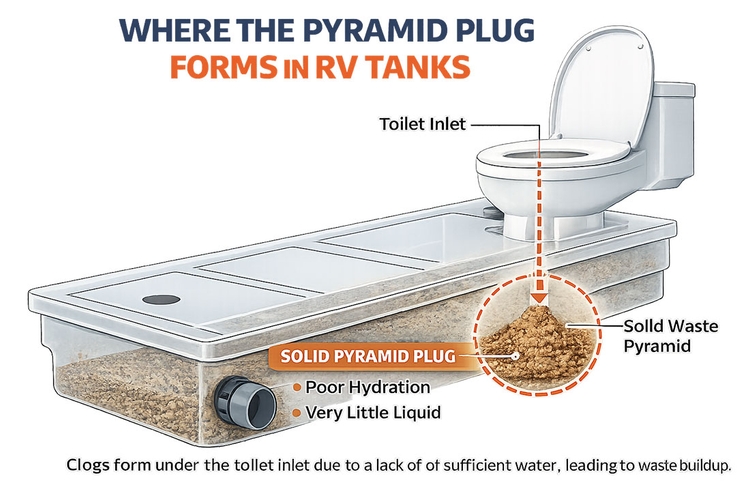
Lack of hydration leads to the dreaded poop pyramid - this diagram shows where they form.
Low hydration is one of the most common causes of RV tank clogs.
When insufficient water is present, several mechanical changes occur inside the tank.
1. Waste Thickens
Without enough liquid, solids compress together and form dense layers.
This increases waste viscosity and creates the familiar “pyramid plug” that many RV owners experience.
2. Suspension Fails
Waste must remain suspended to move toward the dump outlet.
If hydration is too low, solids settle to the tank floor and begin compacting.
Over time this can create hardened buildup.
3. Odor Formation Increases
Dry tanks concentrate organic waste.
This accelerates the formation of gases like:
- hydrogen sulfide
- ammonia
- volatile fatty acids
These compounds are responsible for the classic RV sewer smell.
A deeper chemical explanation of these gases is discussed in our article on why RV tank odors form.
When a “Poop Pyramid” Is Actually a Frozen Tank Problem
Not every pyramid plug forms because of poor flushing habits. In cold climates, freezing temperatures can create a similar blockage even when the tank normally operates correctly.
One full-time RVer recently shared their experience after encountering their first serious tank blockage during an extreme cold snap on the U.S. East Coast.
Despite using normal flushing practices, temperatures dropped low enough that the contents of the black tank partially froze.
When waste enters a tank that already contains frozen material, it can begin stacking directly below the toilet inlet — forming a mound that looks very similar to a traditional pyramid plug.
Why Frozen Tanks Are Difficult to Clear
Once freezing occurs inside a holding tank, several factors make the blockage harder to resolve:
- Frozen waste cannot move or suspend in liquid
- Water added through the toilet may freeze before penetrating the blockage
- Standard tank treatments cannot distribute through frozen material
- The dump valve may be partially blocked by solidified waste
In the case above, the RVer initially attempted to use a popular enzyme-based tank treatment, but it had little effect because the tank contents were frozen solid.
Enzyme and bacterial products require liquid water and moderate temperatures to function. When waste freezes, biological activity effectively stops.
The tank eventually required a professional cleaning service that worked the blockage from both the toilet inlet and the dump valve.
Preventing Winter Tank Blockages
If you RV in freezing conditions, preventing tank freezing becomes critical.
Some helpful practices include:
- keeping tanks well hydrated
- maintaining heated tank compartments if available
- using RV skirting in cold weather
- dumping tanks before long exposure to freezing temperatures
Maintaining proper hydration remains important even in winter because higher liquid content reduces the risk of dense frozen waste buildup.
You can also learn more about cold-weather RV plumbing risks in our guide on RV sewer hose and holding tank freezing.
Suspension Mechanics: Why Waste Needs Water
RV tanks work best when waste exists as a semi-liquid suspension.
This allows particles to move freely during tank dumping.
Proper suspension helps:
- reduce buildup on tank walls
- improve evacuation efficiency
- prevent sensor fouling
- maintain smoother tank flow
Without sufficient hydration, solids become immobile and start sticking to surfaces.
Waste Viscosity and Tank Performance
Viscosity refers to how thick a fluid becomes.
Examples include:
- Water → very low viscosity
- Syrup → moderate viscosity
- Sludge → extremely high viscosity
When RV tanks become dehydrated, waste viscosity increases dramatically.
High viscosity waste tends to:
- stick to tank walls
- coat tank sensors
- drain slowly
- form clogs
Maintaining adequate hydration keeps the tank contents mobile and easier to evacuate.
Hydration and Dumping Efficiency
Effective tank dumping depends on fluid velocity.
When tanks contain sufficient liquid, dumping creates stronger hydraulic flow that carries solids out of the tank.
Dry tanks often produce:
- slow discharge
- uneven flow
- residual buildup left behind
This leftover material can gradually accumulate over time.
How Much Water Should You Add to an RV Black Tank?
A widely recommended practice among experienced RV owners is to begin each tank cycle with water.
After dumping your tank, add approximately 3–5 gallons of water.
This initial liquid layer helps prevent solids from sticking to the bottom of the tank.
During regular use:
- flush with adequate water
- avoid dry flushing
- allow tanks to reach 2/3 full before dumping
This helps maintain proper suspension.
Hydration and RV Tank Treatments
Many RV owners focus heavily on tank additives.
However hydration often plays an equally important role.
Without enough water:
- enzymes cannot disperse properly
- bacteria cannot move through waste
- odor-control agents cannot distribute evenly
Hydration ensures treatments interact effectively with waste materials.
For a deeper technical explanation of these mechanisms, see our technical brief on hydration dynamics in RV tanks.
Signs Your RV Tank Hydration Is Too Low
- Slow dumping performance
- Persistent sewer odors
- Tank sensors reading incorrectly
- Frequent clog formation
If you notice these symptoms, increasing hydration is often the simplest solution.
Hydration Best Practices for RV Tanks
- Add water after every dump
- Flush toilets with sufficient water
- Allow tanks to reach at least 2/3 full before dumping
- Maintain balanced tank treatment usage
- Avoid leaving tanks completely dry during storage
Related RV Tank Guides
If you're troubleshooting tank issues, these guides may also help:
- How to Unclog an RV Black Tank
- How to Deep Clean an RV Black Tank
- Why Your RV Smells Like Sewage
- Complete Guide to RV Black Tank Care
Final Thoughts
RV holding tanks are simple systems, but they rely on specific fluid conditions to work properly.
Maintaining proper hydration helps ensure:
- waste remains suspended
- odors stay controlled
- tanks dump efficiently
- clogs are prevented
Understanding RV tank hydration is one of the most effective ways to keep your holding tank system operating reliably.
RV Tank Hydration FAQs
How much water should be in an RV black tank?
Most RV experts recommend starting each tank cycle with about 3–5 gallons of water after dumping. During normal use, the tank should maintain roughly 70–90% liquid content so solid waste remains suspended and can flow out during dumping.
What causes a poop pyramid in an RV tank?
A pyramid plug forms when there is not enough water inside the tank. Solid waste drops directly beneath the toilet inlet and begins stacking instead of remaining suspended in liquid.
Can RV black tanks freeze in winter?
Yes. In extreme cold temperatures the contents of a holding tank can partially freeze. When frozen material accumulates beneath the toilet inlet it can form a blockage similar to a traditional pyramid plug.
Why does hydration matter in RV holding tanks?
Hydration controls how waste behaves inside the tank. When liquid levels are high enough, solids remain suspended and can flow during dumping. Low hydration increases waste viscosity and can lead to clogs, odors, and sensor problems.