




RV Repair Cost Index 2025: What Owners Are Really Paying
Posted by Happy Campers Store on Dec 15th 2025
RV Repair Cost Index 2025: What Owners Are Really Paying
A practical, data-inspired look at the most common RV failures, what repairs really cost, and how to avoid the worst bills.
Updated for 2025. Built for everyday RVers, full-timers, and anyone shopping for a rig.
Why this guide matters
RV forums, Facebook groups, and campground conversations are full of the same question: “Is this repair quote normal, or am I getting ripped off?”
This RV Repair Cost Index pulls together real-world ranges and common failure patterns so you can budget smarter, push back on bad quotes, and avoid preventable breakdowns.
Key Takeaways: RV Repair Costs in 2025
Average shop hourly rate
$145–$195/hr
Most RV dealers and big shops in 2025 fall in this range, before parts.
Typical repair bill
$450–$1,200
Most non-drivetrain repairs land somewhere in this range.
Most expensive category
Roof & water damage
Major water intrusion or delamination can easily jump to $5,000+.
Most preventable costs
Tank & plumbing issues
Good tank habits and winterizing prevent lots of $300–$800 bills.
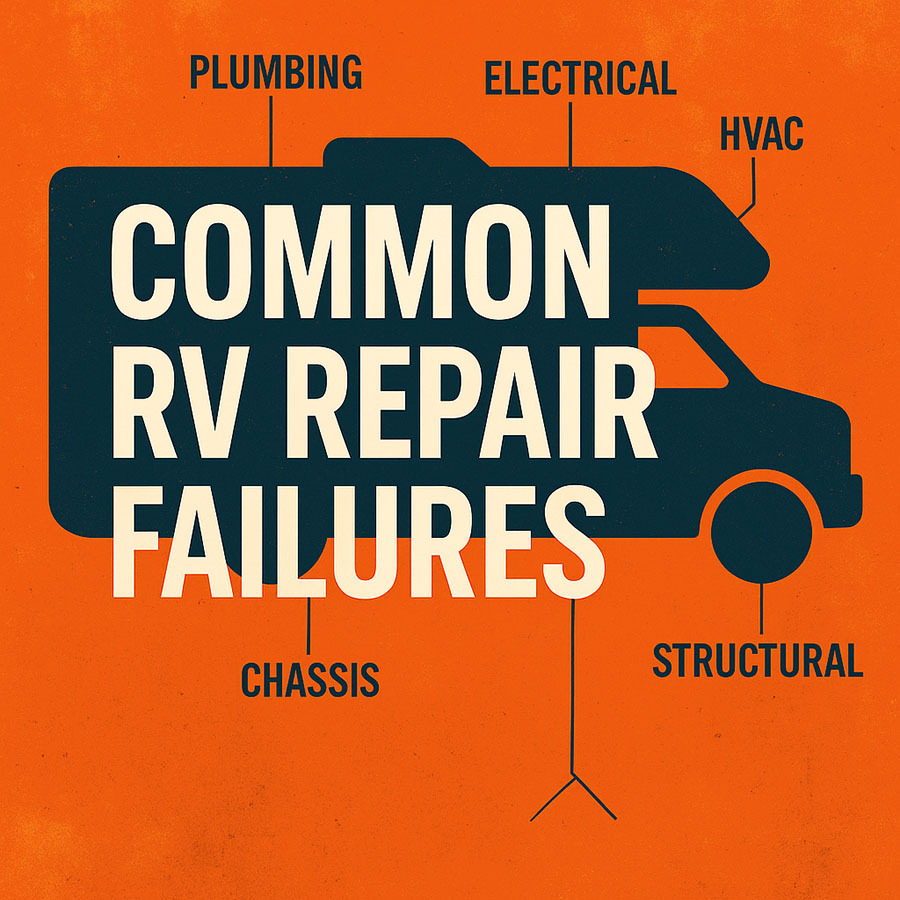
How We Built This RV Repair Cost Index
This isn’t a theoretical list pulled from a manufacturer brochure. It’s a practical, real-world snapshot based on:
- Public RV repair rate sheets and posted labor rates from dealerships and mobile techs.
- Real quotes and invoices shared by RV owners in online forums and groups.
- Patterns we see every day as RV tank and plumbing specialists at Happy Campers.
Dollar ranges are typical for 2025 in the U.S. and will vary by region, rig type, and shop. Think of these as “am I in the ballpark?” reference numbers, not guaranteed prices.
Plumbing & Holding Tank Repair Costs (2025)
Plumbing and holding tank issues are some of the most common—and most preventable—RV problems. They also impact your comfort faster than almost anything else.
| Repair | Typical Cost Range* | Notes |
|---|---|---|
| Black tank replacement | $1,100–$3,000 | Tank cost + 6–15 hours labor. Higher for hard-to-access installs. |
| Tank valve replacement (black or gray) | $150–$450 | Lower for simple 3″ valves, higher if plumbing needs rework. |
| Full black tank cleaning / “reset” | $250–$600 | Professional tank service; price varies by region and severity. |
| Toilet replacement | $200–$900 | Basic plastic models are cheaper; porcelain + labor adds up. |
| Toilet seal / ball valve repair | $120–$300 | Often a quick job if parts are on hand. |
| Sensor diagnosis & cleaning | $90–$250 | Many shops charge a 1–2 hour minimum to inspect and flush. |
| Fresh water leak diagnosis & repair (PEX/fitting) | $180–$650 | Depends on how deep they need to chase the leak. |
*Ranges assume common travel trailer / fifth wheel / Class C setups in 2025 U.S. dollars.
Save hundreds by preventing tank problems in the first place
Most tank valve failures are caused by mechanical issues such as worn cables, seals, or corrosion—a tank treatment can’t prevent those. But a large number of tank problems that lead to expensive service calls come from the waste inside the tank itself: accumulated solids (“pyramids”), hardened sludge around the valve gate, paper buildup, grease in gray tanks, sensor disruption, and odor-causing anaerobic waste. These are all issues that a properly formulated mineral-based treatment can help prevent by breaking down organic waste, keeping solids suspended, and reducing the conditions that cause buildup—especially when paired with good water use and regular seasonal deep cleans. That’s exactly why we created our mineral-based Happy Campers Holding Tank Treatment and our Extreme Cleaner.
Electrical System Repair Costs
Electrical problems spike every summer and after storage: dead batteries, converter failures, and slide-out issues top the list.
| Repair | Typical Cost Range | Notes |
|---|---|---|
| Converter replacement | $400–$900 | Parts + 2–4 hours labor. |
| House battery replacement (pair of 6V or 12V) | $300–$900 | Flooded lead-acid on the low end; AGM/LiFePO4 higher. |
| Slide-out motor or gear repair | $450–$1,500 | Complex mechanisms and access drive cost. |
| GFCI / outlet troubleshooting & repair | $120–$350 | Usually 1–2 hours unless rewiring is needed. |
| Shore power / pedestal damage (plug & cord) | $180–$500 | Burned plugs are common when pedestals have low voltage. |
HVAC: Air Conditioner & Furnace Repair Costs
Climate control failures are some of the most disruptive RV problems—especially if you’re full-timing or camping in extreme heat or cold.
| Repair | Typical Cost Range | Notes |
|---|---|---|
| Rooftop AC replacement (unit + install) | $1,200–$3,000 | Brand/model, ducting, and thermostat integration matter. |
| AC capacitor / fan motor repair | $200–$600 | Common “no cool” fix if caught early. |
| Furnace ignition or board repair | $250–$800 | Includes parts and 2–4 hours labor in many rigs. |
| Thermostat replacement (modern RV) | $160–$450 | Smart control systems can push this higher. |
Roof, Leaks & Structural Repair Costs
Water intrusion is the silent RV killer. It rarely shows up as a cheap repair if you ignore it for long. Learn more in our RV Roof Maintenance & Repairs Guide.
| Repair | Typical Cost Range | Notes |
|---|---|---|
| Roof inspection & reseal (maintenance) | $250–$750 | Annual maintenance that can prevent $5,000+ in damage. |
| Roof membrane replacement | $4,000–$12,000 | Depends on rig size, damage, and shop rates. |
| Localized water damage repair (interior panel, framing) | $800–$3,500 | Highly variable; labor intensive. |
| Wall delamination repair | $3,000–$10,000+ | Often not worth doing on older rigs; insurance may total it. |
Big picture: A $300 roof reseal every year or two is cheap insurance against four- or five-figure structural repairs.
Chassis & Generator Repair Costs (Motorhomes & Tow Rigs)
These numbers vary widely by chassis, engine, and shop, but these ranges will give you a feel for what’s typical in 2025.
| Repair | Typical Cost Range | Notes |
|---|---|---|
| Class C / Class A brake job (axle) | $700–$1,800 | Pads, rotors, and labor; more for heavier diesel pushers. |
| Onboard generator won’t stay running | $250–$900 | Carb cleaning, fuel system work, or control board replacement. |
| Transmission service (tow vehicle or motorhome) | $350–$1,400 | Fluid change on the low end; repairs and rebuilds much higher. |
The 10 Most Common RV Failures in 2025
These are the issues RV owners talk about most in forums and face most often in shops. If you want to keep your costs down, this is the list to focus on.
- Roof leaks & sealant problems — tiny cracks around vents and seams that turn into big water damage.
- Black tank odors & venting problems — sewer smells, methane buildup, and the dreaded “poop pyramid.”
- Battery failure or charging issues — parasitic draws, bad converters, sulfated batteries.
- Fresh water leaks (PEX fittings, pump head) — mystery puddles, swollen flooring, and wet compartments.
- Air conditioner failure — capacitors, fan motors, and full-unit replacements.
- Slide-out motor or gear failure — grinding, sticking, and alignment issues.
- Toilet seal / ball valve issues — bowl won’t hold water, smells creeping into the bathroom.
- Tank valve failures (black or gray) — stuck cables or slow seep into the sewer hose.
- Generator won’t stay running — carb varnish, fuel delivery problems, clogged jets.
- Delamination (water intrusion) — bubbling walls, soft spots, long-term leaks.
If you build your maintenance routine around preventing these ten issues—especially roof leaks, tank problems, and battery care—you’ll avoid most of the expensive repair bills RVers complain about online.
Regional Price Differences: Why the Same Repair Costs More in Some States
Labor and overhead are the main drivers of regional repair price gaps. As a rough rule of thumb for 2025:
- West Coast & Northeast: Highest labor rates, often $170–$195/hr.
- Mountain West & tourist areas: High labor + long wait times.
- Midwest & South: Lower shop rates, sometimes under $140/hr.
- Mobile techs: Often cheaper overall but include a trip fee.
When comparing quotes, always request a breakdown into labor hours, labor rate, and parts costs.
DIY vs. Shop Repairs: Where RVers Save the Most
You don’t need to be a master mechanic to bring your repair costs down. Many RVers handle smaller jobs themselves and leave the complex work to the pros.
Common DIY-friendly jobs
- Replacing faucets or shower heads
- Toilet seal replacement
- Basic roof sealant touch-ups
- Battery replacement
- Routine tank deep cleans
Usually worth hiring a pro
- Roof membrane replacement
- Delamination or framing repairs
- Furnace or propane system work
- Slide-out alignment
- Transmission or brake work
A smart approach is handling simple jobs yourself while keeping a trusted shop or mobile tech for bigger projects.
Want a simple, high-impact DIY win? Learn how to do a proper RV black tank deep clean.
Help Build the Next RV Repair Cost Index
This is our first public RV Repair Cost Index, and we plan to update it every year with more real-world data.
If you’ve had a major repair this year, consider sharing your experience when our survey form launches.
Coming soon: A short survey form for anonymous submissions that will shape the 2026 RV Repair Cost Index.
Next Steps: Where to Go From Here
Use this index as a reality check—not a reason to stress. Focus on preventing the *avoidable* repairs and budgeting for the predictable ones.
These guides pair perfectly with what you learned above:
- The Ultimate Guide to RV Holding Tank Treatments (2025 Edition)
- Why Your RV Smells Like Sewage (And How to Fix It)
- How Often Should You Dump Your RV Black Tank?
- The Ultimate Guide to RV Plumbing Systems
- How to Prevent RV Toilet Stains and Odors
With the right habits, your RV can feel less like a rolling money pit and more like what it’s meant to be: freedom on wheels.