



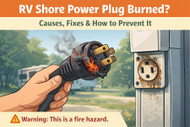
RV Shore Power Plug Burned? Causes, Fixes & How to Prevent It
Posted by Happy Campers Store on Jan 19th 2026
RV Shore Power Plug Burned? Causes, Fixes & How to Prevent It
A burned RV shore power plug is not cosmetic damage — it’s a warning sign of excessive heat caused by electrical resistance. In this guide, we’ll explain exactly why it happens, how to fix it correctly, and how to prevent it from ever happening again.
If a plug, adapter, pedestal outlet, or RV inlet is melted or smells burnt, do not reuse it. Turn the pedestal breaker OFF, unplug, allow it to cool, and repair or replace damaged components before reconnecting.
What a Burned RV Shore Power Plug Really Means
Shore power plugs burn because of excessive resistance at the connection point. Resistance creates heat — often intense heat — right where metal meets metal.
This is why shore power failures often:
- Do not trip a breaker
- Do not show voltage issues on a basic meter
- Get worse gradually over time
The problem is usually mechanical (loose, worn, or corroded contacts), not an electrical “short.” In more severe cases, these failures can contribute to dangerous conditions like RV hot skin electrical faults .
The Most Common Causes (Ranked by Likelihood)
Heat damage like this almost always originates at a loose or worn connection — most commonly the campground pedestal outlet.
1. Worn or Loose Campground Pedestal Outlets
Campground receptacles wear out. Weak internal spring tension leads to poor blade contact, micro-arcing, and rapid heat buildup.
2. Plugging In or Unplugging With the Breaker ON
Plugging in under load creates electrical arcing that pits the metal blades. Those pits increase resistance, which increases heat — even weeks later.
3. Corroded or Oxidized Plug Blades
Oxidation reduces contact surface area. Less contact = more resistance = more heat.
4. Sustained High Electrical Loads
Air conditioners, electric water heaters, space heaters, and microwaves can keep current high for long periods. A marginal connection may fail only under sustained load. Prolonged low voltage from bad shore power can also stress components like your converter — see how to diagnose and replace an RV converter if charging issues appear afterward.
5. Cheap or Underrated Adapters (Dogbones)
Thin internal wiring and weak crimps in low-quality adapters frequently become the hottest point in the chain.
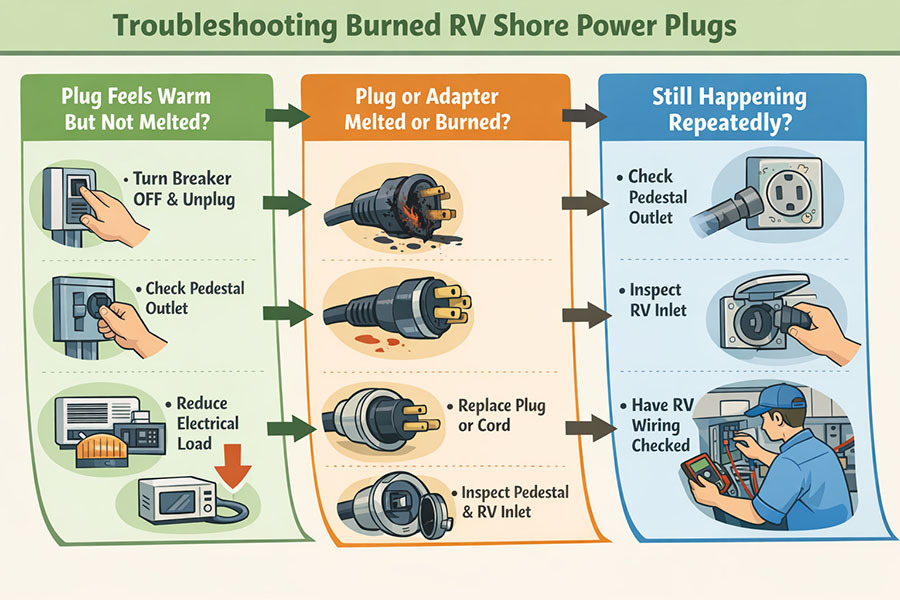
Fast Diagnostic Decision Tree (Use This First)
Plug feels warm but not melted?
- Turn breaker OFF → unplug → inspect blades
- Check pedestal outlet tightness
- Reduce load and re-test
Plug or adapter visibly melted or blackened?
- Do NOT reuse
- Replace plug or cord
- Inspect pedestal AND RV inlet before reconnecting
Problem keeps happening even after replacing the plug?
- Suspect worn pedestal outlet
- Inspect RV inlet for looseness or heat damage
- Have internal wiring checked by an RV technician
Loose Campground Receptacle? Read This Before Plugging In Again
A loose campground pedestal outlet is the #1 cause of burned RV shore power plugs. It is a mechanical failure inside the receptacle — and it cannot be fixed with adapters, tighter plugs, or surge protectors.
These same poor connections are also a known contributor to serious electrical hazards like RV hot skin conditions , where energized frames can deliver shocks.
What to Do Immediately
- Turn the pedestal breaker OFF and unplug
- Do not reuse the outlet if the plug feels loose or gets hot
- Allow the plug and outlet to cool completely before inspection
The Only Safe Solutions
- Request a different campsite or pedestal
- Disconnect and use generator/battery power temporarily
- Wait until campground maintenance repairs the receptacle
Can a Surge Protector Prevent a Burned Plug?
A quality RV surge protector or EMS (Electrical Management System) helps detect miswired pedestals, shut down unsafe voltage, and prevent reconnection after faults — but it cannot correct a loose mechanical connection.
If you’re choosing protection equipment, see our complete comparison guide: The Ultimate RV Surge Protector Buyer’s Guide (2025)
Final Takeaway
A burned RV shore power plug is not bad luck. It’s a signal that something in the power chain is failing — and ignoring it can damage your RV or put your family at risk.
Fix the root cause, not just the plug.