




RV Tank Sensor Statistics: Are Sensors the Most Common RV Holding Tank Problem?
Posted by Happy Campers Store on Jun 11th 2026
RV Tank Sensor Statistics: Are Sensors the Most Common RV Holding Tank Problem?
False RV tank readings, tank gauges stuck at 2/3 full, sensors that read full after dumping, and unreliable black tank monitor panels are among the most frequently discussed RV holding tank complaints.
Early survey results suggest RV tank sensor problems may be one of the most common — and most misunderstood — holding tank issues RV owners face.
Headline Finding
42
Sensor Problem Reports
False readings, stuck sensors, and gauges reading full after dumping were the most frequently reported issue.
28
Tank Odor Reports
Odors remain a major concern, but were reported less often than sensor problems in this early data.
20
Other Issue Reports
Gray tank odors, clogs, and waste pyramid buildup combined were reported less often than sensor problems.
Preliminary Survey Results
Among the first 55 survey responses collected, several clear patterns have emerged. Tank sensor problems currently appear to be the most frequently reported holding tank issue.
76%
Reported Sensor Problems
More than three out of four respondents reported inaccurate tank sensors, false readings, or gauges that continued reading full after dumping.
51%
Reported Tank Odors
About half of respondents reported odor-related tank issues, making odors the second most frequently reported problem.
16%
Reported Gray Tank Odors
Gray tank odors remain a recurring issue and are often associated with grease, soap residue, plumbing vents, or air admittance valves.
11%
Reported Tank Clogs
Clogs were reported less frequently but often create urgent and disruptive holding tank problems.
9%
Reported Waste Pyramids
Waste pyramids were less common but remain strongly associated with low water use and leaving the black tank valve open.
Noteworthy Findings
50%
More Reports Than Odors
Tank sensor problems were reported 50% more often than tank odors in the first 55 survey responses.
#1
Most Reported Issue
Sensor problems currently rank as the most commonly reported RV holding tank issue in the survey.
Rare
Professional Cleaning
Very few respondents reported using professional tank cleaning services before attempting other solutions.
Note: Respondents could report multiple issues. Percentages represent the share of respondents reporting each problem and do not add up to 100%. Findings are preliminary and will continue to be updated as additional survey responses are received.
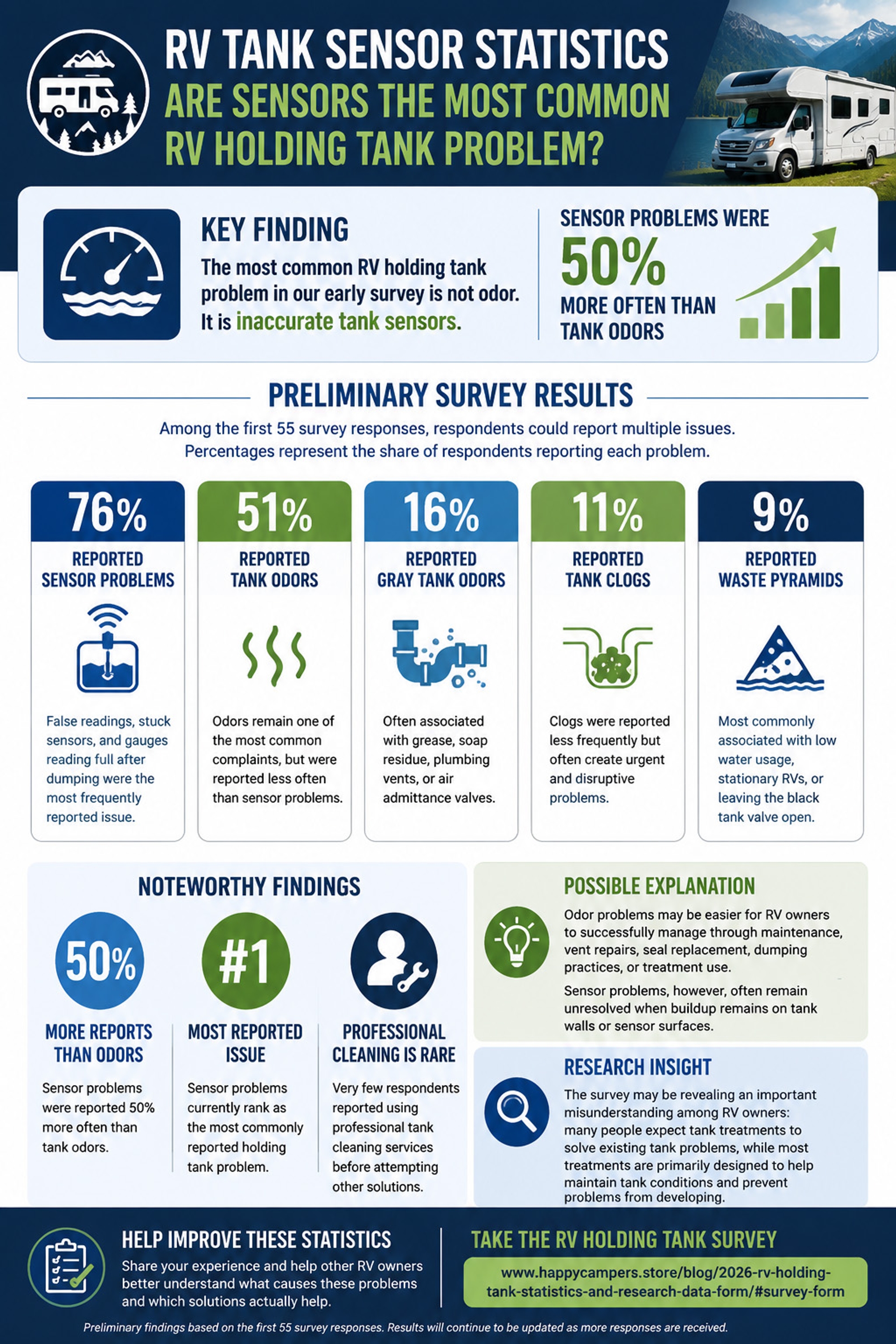
Embed This Infographic On Your Website
Why Tank Sensors May Be the Most Unresolved RV Tank Problem
RV owners often focus on odors first, but our early research suggests tank sensors may be the issue that remains unresolved the longest.
One possible explanation is that odor problems may be easier for RV owners to diagnose and manage through maintenance, vent repairs, seal replacement, dumping practices, or treatment use.
Tank sensors are different.
Many sensor problems are caused by residue, paper fibers, grease, sludge, scale, or buildup on the tank walls and sensor surfaces. Once that buildup is already present, a regular tank treatment may not be enough to remove it.
The Big Misunderstanding: Treatments vs. Cleaners
One of the most important patterns emerging from this research is that many RV owners appear to expect all tank products to work the same way.
They do not.
Many RV tank treatments are designed to help maintain tank conditions during normal use. Depending on the product, they may help with odor control, waste flow, residue reduction, or general tank efficiency.
But if a tank already has an existing problem — such as fouled sensors, hardened buildup, sludge, grease, scale, or waste stuck to the tank walls — a regular treatment may not solve it.
That is where many RV owners get stuck.
They may keep adding treatment after treatment, expecting the product to clean sensors or remove years of buildup, when what the tank may actually need is a dedicated deep RV holding tank cleaning.
Tank Treatments Are Usually Preventative
Most tank treatments should be thought of as maintenance products, not complete repair products.
A Tank Treatment May Help
- Control odors during normal use
- Support better waste flow
- Help maintain tank conditions between dumps
- Reduce recurring residue when used consistently
- Help prevent problems from developing as quickly
A Tank Treatment May Not Fully Remove
- Heavy buildup already stuck to tank walls
- Sensor fouling caused by old residue
- Grease or soap buildup in gray tanks
- Hardened waste deposits
- Scale or long-term contamination
This is a major reason RV owners may continue seeing inaccurate sensor readings even while using tank treatments regularly.
Why Starting With a Clean Tank Matters
The best RV holding tank maintenance routine usually starts with a clean tank.
If an RV holding tank already has buildup, odor-causing residue, or fouled sensors, it may need to be reset before a regular treatment can do its job effectively.
Tank Cleaner
Used to remove existing buildup and reset the tank.
- Helps clean residue from tank walls
- Helps address fouled sensors
- Used when problems already exist
Tank Treatment
Used after cleaning to help maintain better tank conditions.
- Helps control odors
- Supports regular tank maintenance
- Helps reduce recurring problems
This distinction is especially important for RV owners dealing with recurring sensor problems. If the tank walls or sensor surfaces are already contaminated, using more treatment may not be enough.
What Early Survey Responses Suggest
Several early responses point to the same pattern:
- Some RV owners reported sensors still malfunctioning after using treatments.
- Some reported temporary improvement after flushing or rinsing.
- Some saw the problem return after a short time.
- Professional tank cleaning was rarely used.
- Many owners appeared unsure whether they needed treatment, cleaning, or repair.
This may help explain why tank sensors are currently the most frequently reported issue in our survey.
What RV Owners Are Saying
The survey comments help explain why sensor problems may be one of the most persistent RV holding tank issues. While many respondents reported temporary improvements after flushing or cleaning, several indicated the problems eventually returned.
"Tried rinsing and treatments. Sensors read incorrectly. Still haven't solved it."
"A back flush was done several times and the black tank sensor cleared for a short time."
"Black tank sensor reads incorrectly after I empty it. The sensor clears and works well after flushing the tank with Sani Flush."
"BLACK TANK Sensors continue to act-up from time to time. We back flush more frequently."
Help Improve These Statistics
Have you experienced RV tank sensor problems, odors, clogs, gray tank smells, or waste buildup?
Your experience can help other RV owners better understand what causes these problems and which solutions actually help.