



Most RV Fires Don’t Happen the Way Owners Think
Posted by Happy Campers Store on May 1st 2026
Most RV Fires Don’t Happen the Way Owners Think
You’re parked. Plugged into shore power. Dinner is done. The campground is quiet. Everything feels normal — until one overlooked RV system turns into a serious fire risk.
RV fires are not an everyday occurrence, but they are more common than many owners realize. According to U.S. Fire Administration data, fire departments respond to an estimated 4,200 recreational vehicle fires each year in the United States.
Those fires result in an estimated 15 deaths, 125 injuries, and more than $60 million in property loss annually.
The scary part? Many RV fire risks do not look dramatic at first. They often start with something ordinary: a loose plug, a damaged cord, an overloaded outlet, a propane leak, or a cooking appliance left unattended.
Reality check: The biggest RV fire danger is often not the thing you notice — it is the small system problem quietly building behind the scenes.
RV Fire Risks & Prevention (Quick Visual Guide)
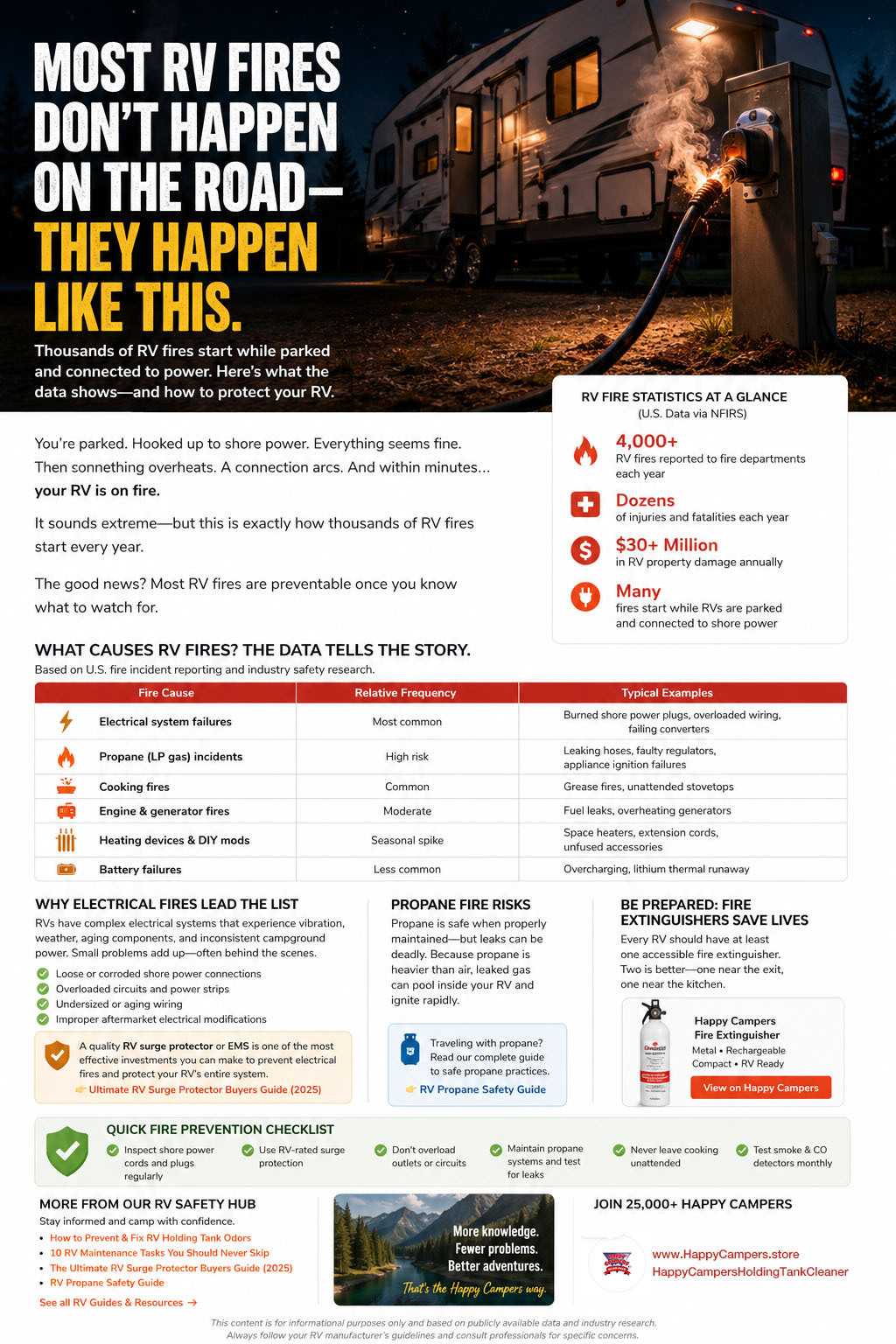
Save this for your next trip or share it with another RV owner.
The Hidden Pattern Behind Many RV Fires
When people picture an RV fire, they often imagine something happening on the highway: an engine fire, a tire blowout, or smoke coming from under the hood.
But RVs are different from ordinary vehicles. They are also tiny homes on wheels, with electrical systems, propane lines, appliances, batteries, heaters, refrigerators, generators, and shore power connections all packed into a compact space.
That means a fire can start while the RV is parked, occupied, stored, plugged in, cooking dinner, charging batteries, or running appliances.
How Common Are RV Fires?
U.S. Fire Administration data from 2018–2020 estimates an average of 4,200 RV fires reported to fire departments each year.
Estimated RV fires per year
Estimated injuries per year
Estimated annual property loss
That does not mean RV owners should panic. It does mean fire prevention should be treated like tire pressure, tank care, roof maintenance, and battery checks: not exciting, but absolutely worth doing.
The RV Fire Risks Owners Miss Most Often
Fire risk usually comes down to a few repeat offenders. Some are obvious. Others hide in plain sight.
| Risk Area | Why It Matters | What to Check |
|---|---|---|
| Shore power | Loose, corroded, or overheated connections can create dangerous heat buildup. | Power cord, plug blades, pedestal, adapters, EMS/surge protector. |
| Propane system | Leaks can collect low inside or around the RV and ignite quickly. | Hoses, regulators, fittings, appliance connections, propane detector. |
| Cooking appliances | Small RV kitchens leave little room between heat, grease, towels, and cabinets. | Stovetop, air fryer, toaster oven, grease, paper towels, curtains. |
| Space heaters | They pull a lot of power and can overload outlets or extension cords. | Outlet condition, cord rating, heater placement, distance from bedding. |
| DIY electrical mods | Unfused accessories, undersized wiring, or poor connections can become fire hazards. | Battery add-ons, solar wiring, inverters, lighting upgrades, accessory circuits. |
Why Shore Power Deserves Extra Attention
Shore power feels harmless because it is so routine. You pull into a campsite, plug in, and move on.
But that connection is feeding power into your RV for air conditioning, charging, outlets, appliances, refrigerators, converters, and more. If the pedestal is faulty, the cord is damaged, the plug is loose, or the connection overheats, you may not notice until there is visible damage.
That is why many RV owners use an RV-rated surge protector or electrical management system before plugging into campground power.
Related guide: The Ultimate RV Surge Protector Buyer’s Guide
The Everyday Items That Can Create RV Fire Risk
The danger is not always a broken RV part. Sometimes it is a normal household item being used in a space that was never designed like a house.
- Household power strips
- Cheap extension cords
- Space heaters placed near bedding or furniture
- Air fryers, toaster ovens, and coffee makers on overloaded circuits
- Electric blankets or mattress warmers
- Candles and wax warmers
- Low-quality phone chargers and USB hubs
- Aftermarket accessories installed without proper fusing
Important: RV outlets, cords, and circuits are not unlimited. If something feels hot, smells odd, flickers, trips breakers, or shows discoloration, stop using it until it is inspected.
Propane Is Safe — Until Maintenance Gets Ignored
Propane systems are common in RVs and can be used safely. The problem is that leaks, cracked hoses, bad fittings, damaged regulators, or appliance issues can turn into a serious hazard.
Propane is heavier than air, which means it can settle low rather than simply floating away. That is why working propane detectors, regular inspections, and leak checks matter.
Related guide: Can You Drive an RV With Propane On?
The Quick RV Fire Prevention Checklist
You do not need to obsess over every worst-case scenario. Start with the basics.
- Use an RV-rated surge protector or electrical management system.
- Inspect your shore power cord and plug for heat marks, melting, or corrosion.
- Do not overload RV outlets with multiple high-draw appliances.
- Keep space heaters away from bedding, curtains, furniture, and cords.
- Test smoke, propane, and carbon monoxide detectors regularly.
- Keep at least one fire extinguisher near an exit and one near the kitchen.
- Have propane lines and fittings inspected periodically.
- Make sure generator exhaust points away from the RV.
- Never leave cooking unattended.
- Have a qualified technician inspect the RV if you smell burning plastic, see flickering lights, or notice repeated breaker trips.
The Bigger Lesson: RV Problems Usually Start Small
This is true across almost every RV system.
A loose electrical connection becomes heat damage. A tiny propane leak becomes a hazard. A slow roof leak becomes rot. A neglected holding tank becomes odor, buildup, and sensor problems.
RV ownership is not about being paranoid. It is about catching small problems before they become expensive, dangerous, or trip-ending.
A Cleaner RV Starts With Better System Care
At Happy Campers, we talk a lot about black tanks, odors, buildup, sensors, and holding tank maintenance — but the bigger idea is simple:
Your RV works better when its systems are maintained before they fail.
That includes your electrical system, propane system, plumbing system, and waste tanks. If you are already checking cords, detectors, and appliances, it is also a good time to make sure your black and gray tanks are being treated consistently between dumps.
Learn more: The Complete Guide to RV Black Tank Care, Cleaning, and Odor Control
More Helpful RV Safety & Maintenance Guides
- Why Your RV Smells Like Sewage — and How to Fix It
- How Often Should You Dump Your RV Black Tank?
- How to Deep Clean Your RV Black Tank
- The $20 RV Part That Can Ruin Your Entire Trip
Final Takeaway
RV fires are not something most owners want to think about — but ignoring the risk does not make it go away.
Check your shore power. Respect your propane system. Do not overload outlets. Keep extinguishers where you can reach them. Test your detectors. And treat RV maintenance like a whole-system routine, not just a repair list.
Because the best RV emergency is the one you prevent before it ever starts.