




What’s Missing Under Your RV? This Hidden Upgrade Could Save You Thousands
Posted by Happy Campers Store on Apr 26th 2026
What’s Missing Under Your RV? This Hidden Upgrade Could Save You Thousands
Most RV owners don’t realize this… until something breaks.
There’s something under your RV right now—and if it’s missing, it could quietly be setting you up for expensive damage.
The strange part?
You probably never think about it.
It’s completely out of sight… which is exactly why it gets overlooked.
Until one day—your plumbing freezes, a valve cracks, or something starts leaking—and suddenly it matters a lot.
What Is an RV Underbelly Protection Kit?
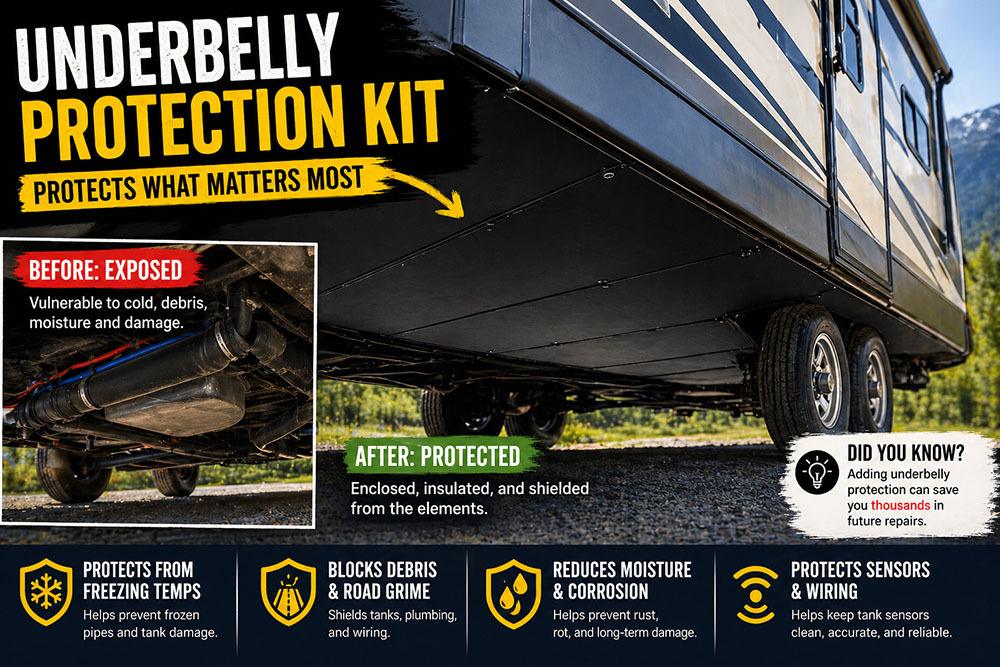
Some RVs come equipped with what’s often called an enclosed or heated underbelly—what we’ll refer to here as an RV underbelly protection kit.
It’s a protective layer installed underneath your RV that:
- Covers exposed tanks and plumbing
- Adds insulation to help regulate temperature
- Blocks wind, road debris, and moisture
- Sometimes includes heating elements for cold weather use
Instead of your tanks and pipes being fully exposed to the elements…
they’re sealed and protected.
Why This Matters More Than You Think
Without underbelly protection, your RV’s most important systems are exposed to:
- Freezing temperatures
- Road spray and grime
- Flying debris
- Extreme temperature swings
That can lead to:
- Frozen pipes
- Cracked fittings
- Damaged valves
- Unexpected and costly repairs
But here’s the part most people don’t think about…
Temperature swings also affect what’s happening inside your holding tank.
Which means even if everything looks “fine”… it may not be working efficiently at all.
Not All RV Underbelly Protection Kits Are Equal
This is where things get interesting.
Some RVs have:
- ✔ Fully enclosed and insulated underbellies
- ✔ Heated tanks and plumbing lines
Others?
- ❌ Thin plastic sheeting with gaps
- ❌ No real insulation
- ❌ Poor sealing that traps moisture
And in some cases… a bad setup can actually make things worse.
Trapped moisture + fluctuating temperatures = a perfect environment for long-term damage and buildup.
Do You Actually Need One?
If You Camp in Cooler Weather…
- Spring and fall trips
- Cold mornings and nights
- Higher elevation camping
Yes—it’s a major advantage.
If You Camp in Freezing Conditions…
It’s not optional—it’s protection.
If You Only Camp in Warm Weather…
You can get by without it—but you’re still missing out on protection and long-term system reliability.
What Does It Cost to Add RV Underbelly Protection?
This is where a lot of RV owners get surprised.
Adding an RV underbelly protection kit after purchase is almost always more expensive than having it built in from the factory.
- Basic DIY kits: around $150–$500
- Professional enclosed installs: $500–$1,500+
- Heated underbelly systems: $1,500–$3,000+
And most people don’t even realize they need this… until after something goes wrong.
Retrofitting can also be more complicated, since installers have to work around:
- Existing plumbing
- Holding tanks
- Wiring and valves
- Frame supports and access points
Now Compare That to This…
- Frozen pipe repair: $300–$1,000+
- Valve or fitting damage: $500–$2,000+
- Major plumbing repairs: potentially much more
Suddenly, it’s not really an “upgrade”… it’s protection.
Here’s the Part Nobody Talks About
Even with a fully enclosed underbelly… your tank system can still have problems.
Because:
- Insulation doesn’t remove buildup
- Protection doesn’t eliminate odors
- Temperature control doesn’t clean your tank
It only protects the outside of the system—not what’s happening inside it.
And that’s where a lot of RV owners get caught off guard.
What About Your Tank Sensors and Wiring?
This is something almost no one talks about—but it matters more than you think.
Your RV’s holding tank sensors rely on small probes and wiring that are often exposed underneath the rig.
Without proper underbelly protection, those components are vulnerable to:
- Road grime and debris
- Moisture and corrosion
- Temperature swings
- Loose or damaged wiring connections
And when that happens… your sensors start lying to you.
Showing 2/3 full when the tank is empty. Reading full when it’s not. Or just not working at all.
Adding an RV underbelly protection kit can help shield this wiring and reduce exposure to the elements.
But here’s the key:
Protection helps prevent damage—but it doesn’t fix dirty or fouled sensors.
If buildup or residue is already coating the probes inside the tank…
you’ll still get bad readings no matter how protected the wiring is.
That’s why sensor issues are almost always a combination of:
- External exposure (wiring, moisture, damage)
- Internal buildup (waste, residue, paper)
And fixing the problem means addressing both.
If your sensors aren’t reading correctly, don’t assume they’re broken.
Sometimes they’re just dirty—and sometimes the issue is underneath your RV, not inside the tank.
The Overlooked Benefit: Tank Performance
More stable temperatures can help your system perform better—but they don’t solve everything.
If waste starts to build up, if odors develop, or if your tank isn’t breaking things down properly…
no amount of insulation will fix that.
That’s why the best setups focus on both:
- ✔ External protection (underbelly protection kit)
- ✔ Internal tank performance (proper maintenance and treatment)
When those two things work together…
you avoid the problems most RV owners eventually run into.
Quick Check: Does Your RV Have This?
Take a quick look underneath your RV:
- If you see exposed tanks and pipes → You likely don’t have underbelly protection
- If everything is enclosed → You probably do
And if you’re not sure?
That alone is worth checking.
Final Thought
Most RV owners spend thousands on upgrades they can see—
The interior, the layout, the features.
But ignore one of the most important protections they can’t.
And by the time it becomes obvious…
It’s usually because something already went wrong.
So the next time you’re walking around your RV—
take a look underneath.
You might discover something you didn’t even know was missing.