


Why Do RV Owners Use Tank Treatments? Understanding the Expectation Gap
Posted by Happy Campers Store on Jun 16th 2026
Why Do RV Owners Use Tank Treatments? Understanding the Expectation Gap
RV owners use holding tank treatments for many different reasons. Some want odor control. Others expect waste breakdown, clog prevention, sensor maintenance, or general tank performance.
Early survey results suggest one of the biggest sources of frustration may not be whether RV tank treatments work, but whether owners are using them to solve the right problem.
Why RV Owners Say They Use Tank Treatments
As part of the 2026 RV Holding Tank Research Project, RV owners were asked why they use holding tank treatments. Respondents could select more than one reason.
Among the current responses, RV owners submitted 149 total reasons for using tank treatments.
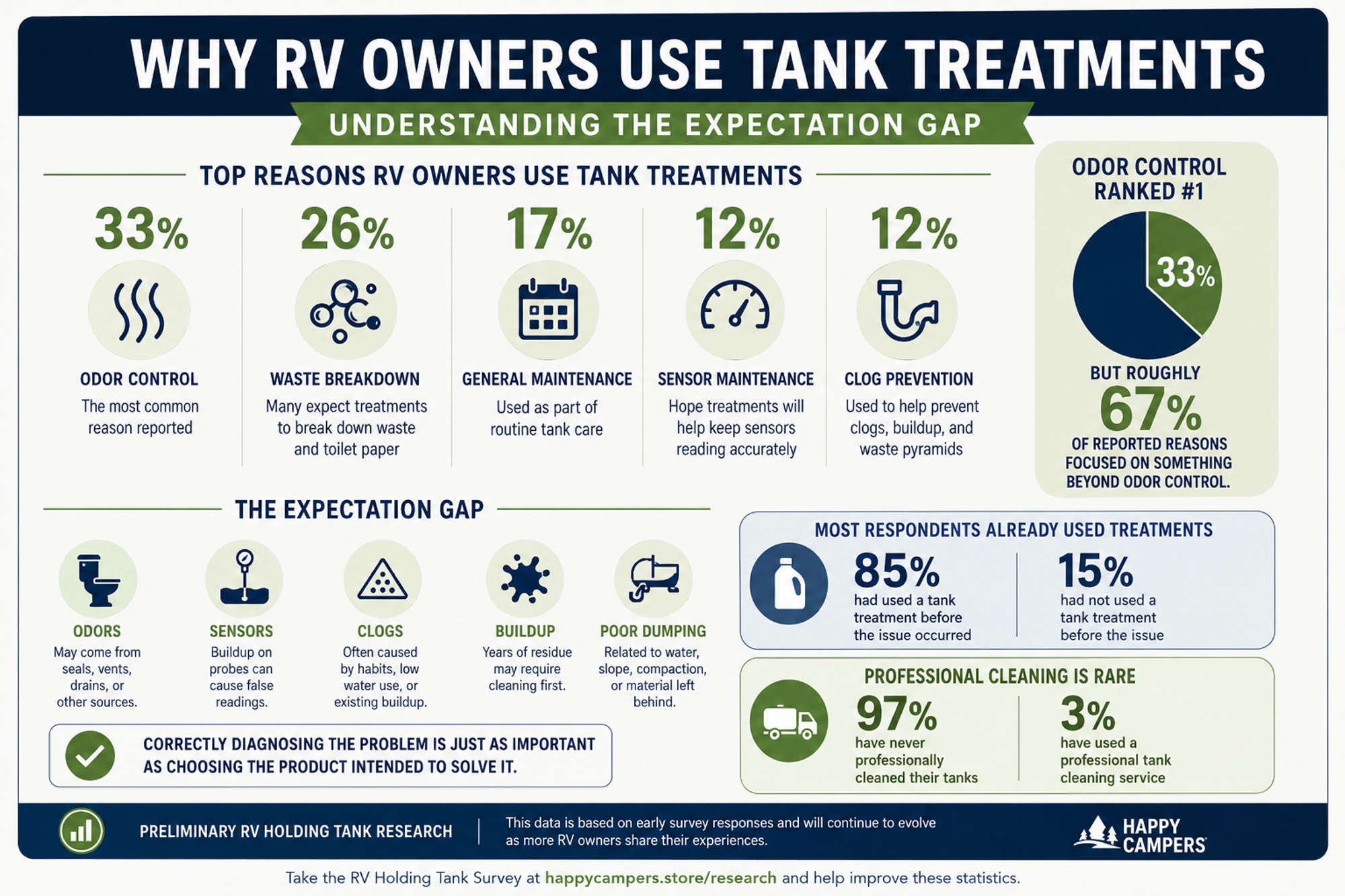
33%
Odor Control
The most common reason RV owners reported using tank treatments.
26%
Waste Breakdown
Many owners expect treatments to help break down waste and toilet paper.
17%
General Maintenance
Some owners use treatments as part of their regular tank care routine.
12%
Clog Prevention
Some owners use treatments hoping to prevent clogs, buildup, and waste pyramids.
Note: Respondents could select multiple reasons. Percentages are based on total selected reasons and do not represent the percentage of all RV owners.
Embed This Infographic On Your Website
The Expectation Gap
One of the clearest themes emerging from the survey is not that RV tank treatments do not work.
It is that many RV owners expect tank treatments to solve problems they were never designed to solve by themselves.
When a symptom is misdiagnosed, disappointment is almost inevitable. A treatment may be blamed for “failing,” when the real issue may be a seal, vent, drain, sensor buildup, water-use problem, dumping habit, or existing buildup inside the tank.
Odors
A treatment may help with tank odor, but it will not fix every odor source. Smells can also come from toilet seals, roof vents, gray tank drains, air admittance valves, or dried-out P-traps.
Sensor Problems
If sensor probes are coated with film, residue, or buildup, routine treatment alone may not restore accurate readings. The tank may need cleaning first.
Clogs
Clogs and waste pyramids are often related to low water use, open black tank valve habits, toilet paper accumulation, poor dumping habits, or existing buildup.
Existing Buildup
Years of residue, scale, or hardened waste may require a dedicated cleaning process before routine maintenance products can perform as expected.
Poor Dumping
Poor dumping performance may be caused by buildup, insufficient water, tank slope, waste compaction, or material left behind after previous dumps.
Wrong Solution
A tank treatment can be part of the solution, but it cannot correct every cause of odor, clogging, sensor failure, or buildup by itself.
Why Waste Breakdown Became Such a Big Part of the Conversation
Waste breakdown has become one of the most common ideas in the RV tank treatment category.
Many products are marketed around enzymes, bacteria, digestion, liquefaction, or visual demonstrations showing toilet paper and waste breaking apart in a container.
It is easy to understand why many RV owners now believe that if waste breaks down, everything else will take care of itself.
Breaking waste down can be useful, but waste breakdown alone does not automatically guarantee odor control, clean sensors, proper dumping, clean tank walls, or long-term tank performance.
Material that has been loosened or partially broken down can still remain behind after dumping. Residue may cling to tank walls, collect near sensors, or settle toward the bottom of the tank depending on water levels, tank shape, dumping habits, and existing buildup.
In other words, dramatic breakdown demonstrations do not necessarily tell the entire story of real-world RV holding tank performance.
Different Approaches to RV Tank Performance
Not every RV tank treatment is designed to work the same way.
Enzyme-Style Treatments
Enzyme-style tank treatments often focus on digestion, liquefaction, and breaking down waste and toilet paper.
This approach has become familiar to many RV owners because it is easy to demonstrate visually.
The Happy Campers Method
Happy Campers uses a different approach. Instead of focusing on digestion as the main measure of performance, Happy Campers is designed to help condition the tank environment, control odors, and support normal waste movement during dumping.
A product does not need to be an enzyme digester to perform well in real RV tank conditions.
Most Respondents Were Already Familiar With Tank Treatments
In the early survey responses, most RV owners said they had already used some form of tank treatment before experiencing the issue they reported.
This does not mean tank treatments caused the problem, or that tank treatments do not work. It simply means many RV owners are not starting from zero when a problem appears.
In many cases, the issue may not be whether a treatment was used. The bigger question may be whether the symptom was correctly diagnosed.
A treatment may be part of the solution, but it cannot correct every cause of odor, sensor failure, clogging, or buildup by itself.
Professional Tank Cleaning Was Rare
Another important finding from the early responses was that professional tank cleaning was uncommon.
97%
Had Not Professionally Cleaned Their Tanks
Most respondents had never used a professional tank cleaning service.
3%
Had Professionally Cleaned Their Tanks
Only a small number reported professional tank cleaning.
This matters because existing buildup may go unrecognized for years.
When that happens, RV owners may expect routine maintenance treatments to solve conditions that may actually require cleaning first.
What RV Owners Said in Their Own Words
The open-ended responses showed how differently RV owners think about tank treatments.
"Odor control."
"Waste breakdown and clog prevention."
"Odor control and sensor function."
"That waste is able to be removed from the holding tank with no clogs."
"Keeping tanks cleaned."
"Sensor readings."
Why RV Owners Choose a Specific Treatment
We also asked RV owners why they chose the treatment they currently use.
Many responses were based on trust, experience, reviews, and recommendations.
Recommendations
"A friend recommended it and it works great."
"Recommended on YouTube."
"It was highly recommended on several RV sites."
Experience
"Been using it for 10 years with no problem."
"Once used and saw how effective it was, have not looked back."
"It works."
These responses suggest that many RV owners choose tank treatments based on real-world experience and word of mouth, not just product claims.
Many RV Owners Are Not Sure How Tank Treatments Work
Another important finding came from a question about how RV owners believe tank treatments work.
29%
Enzymes or Bacteria
Respondents believed most treatments work by using enzymes or bacteria.
25%
Not Sure
Respondents said they were not sure how tank treatments work.
15%
Odor Control
Respondents believed treatments primarily work by controlling odors.
11%
Liquefying Waste
Respondents believed treatments work by liquefying waste and toilet paper.
10%
Same Basic Method
Respondents believed most treatments work essentially the same way.
10%
Different Methods
Respondents recognized that some products work differently than others.
Not all treatments are designed the same way, and not every product is trying to solve the same problem through the same method.
What This Means for RV Owners
The early data suggests that RV owners are not just buying tank treatments for one reason.
They are using them for odor control, waste breakdown, general maintenance, sensor performance, clog prevention, and peace of mind.
But when one product category is expected to solve every holding tank issue, frustration can happen.
Questions to Ask First
- Is the issue odor, sensor readings, clogging, poor dumping, or buildup?
- Is the odor coming from the black tank, gray tank, toilet, vent, or drain?
- Are the sensors dirty, coated, or failing?
- Is there existing buildup inside the tank?
- Are water levels or dumping habits contributing to the problem?
The Better Process
- Diagnose the symptom.
- Clean the tank if buildup already exists.
- Maintain the tank consistently afterward.
- Adjust habits like water use and dumping practices when needed.
Early Research Snapshot
60
Survey Respondents
Current early response sample.
149
Reasons Submitted
Many RV owners selected more than one reason for using tank treatments.
33%
Top Reason: Odor Control
Odor control was the most common reason reported.
The biggest lesson from this research is not that RV owners are using tank treatments incorrectly.
It is that they are often using them with very different expectations.
Odor control, waste breakdown, sensors, clogs, maintenance, and dumping performance are not always the same problem, and they do not always have the same solution.
Help Improve These Statistics
Have you experienced RV tank odors, sensor problems, clogs, gray tank smells, waste buildup, or product disappointment?
Your experience can help other RV owners better understand what causes these problems and which solutions actually help.